Poland's Constitutional Tribunal crisis deepened on November 1, 2026, as Prime Minister Donald Tusk defended his government's handling of the court after President Karol Nawrocki accused him of staging a forced takeover of one of the country's most important institutions. The stand-off, which brought riot police to the tribunal's Warsaw headquarters and protesters into the streets, has become the sharpest test yet of a decade-long fight over who controls Poland's judiciary.
The immediate trigger came late on Friday, October 30, when the tribunal's longest-serving judge, Anna Korwin-Piotrowska, announced that she had suspended the tribunal's president, Bogdan Swieczkowski, and its vice-president, Bartlomiej Sochanski, for a month and had taken charge of the court herself. Justice Minister Waldemar Zurek, who is also the prosecutor general, said he had asked for the immunity of both men to be lifted so that legal proceedings, which could lead to criminal charges, could begin.
According to Reuters, the tribunal said on Friday that Korwin-Piotrowska had suspended Swieczkowski, an appointee of Tusk's nationalist predecessors, and was now in charge of the court. The announcement set off a rapid chain of events. Police surrounded the court building on Friday afternoon, and by the evening protesters linked to the opposition Law and Justice party, known as PiS, had gathered outside, chanting against Tusk and demanding that Swieczkowski be restored.
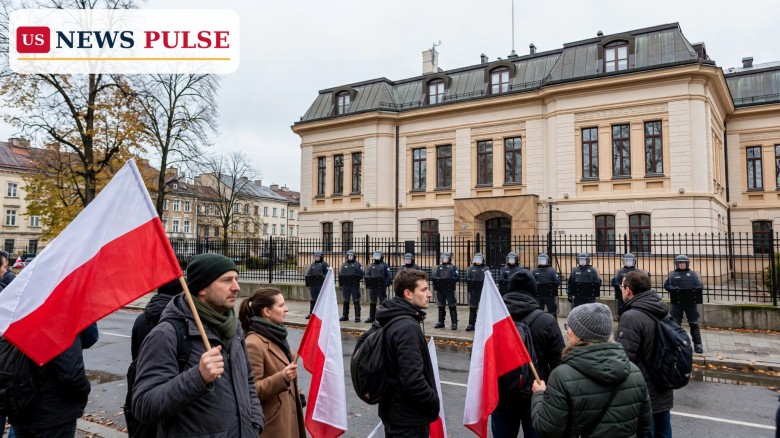
Photographs from Warsaw showed riot police in helmets and shields standing at the entrance to the court, while demonstrators waved Polish flags. Some protesters forced open a metal gate leading to the courtyard outside the headquarters on October 30, according to news agency photographs, and police said three people were detained over alleged attempts to breach the security perimeter and throwing objects at officers.
Nawrocki, who had been travelling to Senegal, turned his plane back late on Friday and headed for the court headquarters in central Warsaw. His chief of staff, Pawel Szefernaker, said that on his return Nawrocki met Swieczkowski and the court's first president, Zbigniew Kapinski, before going to the building itself, where footage from local broadcasters showed him making his way through the crowd to enter.
Early on Saturday, in a statement read by an aide outside the court, Nawrocki said: "Tonight, there was a breach of public order in the Republic of Poland and a forcible takeover of a constitutional body." He said extraordinary talks were needed to defuse what he called a threat to internal security, and he held political consultations throughout Saturday. Talks were due to begin at 1 p.m. local time at the presidential palace.
Zurek, speaking to the broadcaster TVN24, described Nawrocki's behaviour at the court as unacceptable. He said video posted online showed the president forcing his way into the building and shoving judges aside, adding that he hoped the public prosecutor's office would take action. "It is unacceptable for someone protected by presidential immunity to act in this way, forcing their way into a building and assaulting judges," Zurek said.
The Poland Tribunal Crisis did not begin on Friday. It dates back to 2015, when Law and Justice sought to appoint judges to seats already filled by the previous government. Its nominees went on to gain a majority on the Constitutional Tribunal, while critics at home and abroad said the court no longer met the standards of an independent and impartial tribunal established by law.
After Tusk's coalition took office in 2023, it pledged to restore the rule of law and reform the court, but Law and Justice ally Nawrocki has acted to thwart those efforts since his election as president in 2025. Earlier this year, Nawrocki refused to swear in three of six judges nominated by parliament, while Swieczkowski, a former deputy justice minister in the Law and Justice administration, declined to seat judges elected by the current parliamentary majority.
Last month, parliament appointed Tusk ally Maciej Berek to the tribunal, a move critics said undermined the government's stated goal of restoring checks and balances. The tribunal has frequently ruled in favour of Polish legislation over European Union law, and the European Union itself has accused the court of being too close to the nationalist political establishment of the time.
The Tusk government argues that action against the tribunal's senior officials is necessary to restore judicial independence and the rule of law, including addressing what it considers controversial judicial appointments and the functioning of the tribunal. The opposition argues the opposite: that the government is seizing control of an institution it does not control politically. That clash of claims is why both sides now use such stark language, with the tribunal's official account calling the suspension a "coup d'etat" and the government calling it a restoration of legality.
Tusk sought to offer reassurance in a televised speech on Saturday. "I am certain that the Constitutional Tribunal will function as it should. Also, independently of me and in line with the constitution," he said. "The task of the executive branch, and therefore mine, is to ensure its safety and working conditions, and I intend to fulfill my duty."
Writing on X, Tusk added that his government was seeking to restore the rule of law, which the European Union had accused his predecessors of subverting. "This process is difficult, at times even painful, and requires decisive action. There is no other way," he said.
Nawrocki's camp frames the same events as a constitutional rupture. The president denounced what he called a violation of the constitutional order and demanded that police withdraw from the court. Demonstrators outside the building echoed that message, with one protester telling Agence France-Presse that Tusk was "trampling on our constitutional rights," while others chanted "Tusk traitor" and tried to push through security barricades.
The dispute also matters beyond Poland's borders because the tribunal's rulings touch on the relationship between Polish law and European Union law. A court that is seen as politically captured, or a court whose leadership is changed by contested means, both raise questions about legal certainty for citizens, businesses and other EU member states.
The only quotes in this article are those reported by Reuters, Agence France-Presse and Polish broadcasters in their coverage of the stand-off. Tusk's televised assurance that the tribunal would function "independently of me and in line with the constitution" is the government's central public message. Nawrocki's statement about a "breach of public order" and a "forcible takeover of a constitutional body" is the presidency's central counter-claim.
Zurek's televised criticism of Nawrocki, in which he called the president's conduct at the court "unacceptable," shows that the conflict is not only between the government and the opposition, but also between the presidency and the justice ministry. The tribunal's own account, calling the suspension a "coup d'etat," shows how far the institution itself has been drawn into the political fight.
No new ruling from the tribunal itself on the legality of the suspension had been reported by the time of publication, and the question of who lawfully leads the court remains contested. That uncertainty is itself part of the story: a constitutional court whose leadership is disputed cannot easily settle disputes about its own leadership.
The crisis matters for three reasons. First, the Constitutional Tribunal is supposed to be the final arbiter of whether laws comply with Poland's constitution. If its leadership is contested, every major ruling it issues risks being challenged as illegitimate by one side or the other.
Second, the stand-off tests the balance between Poland's president and its prime minister. Nawrocki, aligned with the previous hard-right government, can block nominations and use the presidency as a platform against Tusk's government, while Tusk controls the parliamentary majority and the executive. When those two centres of power disagree about a court, there is no neutral referee left standing.
Third, the crisis arrives as Poland is scheduled to hold parliamentary elections next year. The fight over the tribunal will therefore be fought not only in courtrooms but also in an election campaign, where each side will present itself as the defender of the constitution and the other as its violator.
The immediate next steps are political and legal. Nawrocki's crisis talks at the presidential palace were the first attempt to find a path out of the stand-off, but no agreement had been reported. The request to lift the immunity of Swieczkowski and Sochanski will test whether prosecutors can proceed, and whether the tribunal's own procedures recognise the suspension.
Reports have also pointed to a general assembly of the tribunal scheduled for November 3, 2026, to establish the tribunal's budget for 2027. Whether that meeting goes ahead, who chairs it, and whether its decisions are recognised by all sides will be an early indicator of whether the institution can function at all in its current form.
For now, riot police remain a visible presence around the court, protesters remain mobilised, and the two competing narratives — restoration of the rule of law versus a forced takeover — remain irreconcilable. The next court filing, the next police decision, and the next statement from either the presidency or the prime minister's office will each be watched as a signal of which narrative gains ground.
Who was suspended in Poland's Constitutional Tribunal crisis? Tribunal president Bogdan Swieczkowski and vice-president Bartlomiej Sochanski were suspended for a month on October 30, 2026, by the tribunal's longest-serving judge, Anna Korwin-Piotrowska, according to the tribunal's announcement reported by Reuters.
Why did President Nawrocki return from Senegal? Nawrocki cut short a trip to Senegal late on Friday after Swieczkowski's suspension, returned to Warsaw, met Swieczkowski and the court's first president, and went to the court headquarters, where he later called the events a forcible takeover.
What does Prime Minister Tusk say about the tribunal? Tusk said in a televised speech that he was certain the tribunal would function as it should, independently and in line with the constitution, and that the executive's task was to ensure its safety and working conditions.
How long has the Polish court dispute been going on? The dispute dates back to 2015, when Law and Justice sought to appoint judges to seats already filled, and it intensified after Tusk's coalition took office in 2023 pledging to restore the rule of law.
What happens next in Warsaw? Crisis talks at the presidential palace, the immunity-lift request for the two suspended judges, and a reported November 3 general assembly on the tribunal's 2027 budget are the next milestones to watch.
Related coverage on US News Pulse: Poland's G20 membership backed by Trump as Rubio pushes Warsaw's seat in Atlanta, Trump White House plans to govern without Congress if Democrats win midterms, and Venezuelan TPS returns November 6 as Ninth Circuit rejects Trump stay bid.
Leave a Comment



 | Today's Date: