

 | Today's Date:





Van Gogh's Chestnut Trees in Blossom Sells for Record $190.4 Million - US News Pulse
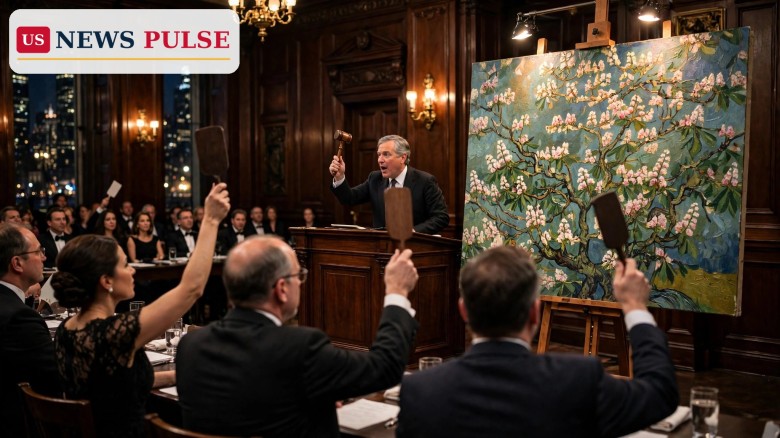
NEW YORK — Vincent van Gogh’s “Chataigniers en fleurs” (“Chestnut Trees in Blossom”) sold at Sotheby’s in New York on Wednesday, November 18, 2026, for $190.4 million, setting a new auction record for the Dutch master.
The 1890 canvas, painted in the final weeks of Van Gogh’s life and unseen in public for more than 50 years, drew a hammer price of $165 million before fees. It is now the fourth-most expensive painting ever sold at auction, and the second-highest price ever achieved at Sotheby’s.
Key Points
- Van Gogh’s “Chestnut Trees in Blossom” (1890) sold at Sotheby’s New York on Wednesday for $190.4 million including fees, on a $165 million hammer price — an auction record for the artist.
- The previous Van Gogh record was $117.2 million, set in November 2022 at Christie’s for “Verger avec Cypres”, from Paul Allen’s collection.
- The New York Times reported the winning bidder was dealer William Acquavella, head of Acquavella Galleries; Sotheby’s did not name the buyer.
- The sale went ahead a day after Sotheby’s announced a settlement between the Blaquier-Arrieta family, owners since 1975, and the heirs of Samuel Fischer, who said it was sold under duress in 1936.
- It is the second-highest price ever at Sotheby’s, behind Klimt’s “Portrait of Elisabeth Lederer”, which sold for $236.4 million in November 2025.
What Happened
The painting was the centrepiece of the evening sale at Sotheby’s New York, the star lot of 12 masterpieces from the Blaquier-Arrieta Collection. Bidding passed the $180 million estimate before the hammer fell at $165 million, with fees taking the final price to $190.4 million.
All 12 works sold, fetching $412 million against an estimate of about $450 million. Cézanne’s “Harlequin” was the night’s second-biggest lot at $111 million with fees, and records were also set for Mary Cassatt and Aaron Douglas. Across the two evening sales, Sotheby’s took in $663.26 million before fees, or $777.8 million with fees.
Background and Context
Van Gogh painted “Chestnut Trees in Blossom” in 1890, days after arriving in Auvers-sur-Oise, where he spent the final two months of his life. It shows a lush row of flowering chestnut trees lining a village road, where a solitary man in a hat, thought to possibly represent the artist himself, walks past three women with parasols. Its thick, vivid brushstrokes connect it with “The Starry Night” and “The Church at Auvers-sur-Oise”.
Samuel Fischer, founder of a great German publishing house, bought it in Paris in 1909. His family fled Germany after the Nazis came to power, and the work was sold in Amsterdam in 1936; the heirs said the sale was made under duress. The Argentina-based Blaquier family acquired it in 1975, and it had not been seen in public for more than half a century. Before the settlement, Sotheby’s maintained its research “has not established that the painting was sold under duress”, citing a 1936 price of 68,000 Swiss francs, about $22,000.
Van Gogh’s Chestnut Trees in Blossom: A $190.4 Million Record
The $190.4 million result travelled far past the $180 million estimate, itself the highest of New York’s autumn auction week. It beats the old Van Gogh record by more than $73 million, about 63 percent, and underlines how scarce top-tier Van Goghs have become.
Van Gogh produced around 900 paintings in a career of just ten years, and most of the best are already in museums, where they will never be sold. A large, late, museum-quality canvas in private hands, fresh to the market after half a century out of sight, is the kind of lot that appears perhaps once in a generation. The sale was backed by a guarantee, yet bidding went well beyond that floor.
Reactions and Quotes
Sotheby’s called the painting “among the most exceptional Post-Impressionist paintings ever to come to the market” and “one of the most important works from that era of van Gogh’s career remaining in private hands”.
The buyer’s identity was the night’s other talking point. Sotheby’s did not name the buyer, but the New York Times reported the prevailing bidder was William Acquavella, the dealer who heads Acquavella Galleries. Neither side commented on the settlement terms; Sotheby’s said only that it had helped broker the deal.
Why It Matters
The sale matters first because of the restitution story. Thousands of works changed hands in Europe in the 1930s and 1940s under the pressure of persecution, and many are now worth tens or hundreds of millions of dollars. This case shows such claims can be settled, even at the last minute, rather than ending in a courtroom or a cancelled sale.
It also shows the top of the art market remains strong: buyers will still pay almost any price for a genuinely rare masterpiece. And it measures how completely Van Gogh’s reputation has changed since his death in 1890, largely unrecognised — one of his late Auvers paintings has now sold for nearly $200 million after 50 years out of sight.
What Happens Next
Attention now turns to the buyer. If the reports naming Acquavella are confirmed, the art world will watch whether the painting is placed with a museum, lent for display, or held privately. A work hidden for half a century could return to public view, or disappear again for decades.
The settlement terms remain private, so it is not known what the Fischer heirs received. The deal may still become a model for other Nazi-era claims, showing a negotiated agreement can be reached even on the eve of a sale.
Frequently Asked Questions
How much did the Van Gogh painting sell for?
$190.4 million including fees, on a $165 million hammer price, at Sotheby’s New York on Wednesday, November 18, 2026.
What was the previous Van Gogh auction record?
$117.2 million, set in November 2022 at Christie’s for “Verger avec Cypres”, from Paul Allen’s collection.
Who bought the painting?
Sotheby’s did not name the buyer; the New York Times reported it was dealer William Acquavella.
Why was there a dispute over the painting?
The heirs of Samuel Fischer, who bought it in Paris in 1909, said it was sold under duress in Amsterdam in 1936 after the family fled Nazi Germany. It was settled the day before the sale.
Where does the price rank among auction records?
Fourth-most expensive painting ever sold at auction, and the second-highest price at Sotheby’s, behind Klimt’s $236.4 million “Portrait of Elisabeth Lederer”.
Related coverage: The $180 million Van Gogh auction went ahead despite a Nazi-era claim, Nanotyrannus Jodi sells for $47.3 million at Sotheby’s New York, and Kobe Bryant’s high school jersey sells for a record $2.2 million at Sotheby’s.

The US News Pulse newsroom covers breaking news across the United States and the world, working from wire services, official statements and on-the-record sources. Every story is reviewed against our editorial standards before publication. Corrections and tips: info@usnewspulse.com
About our newsroomLeave a Comment