

 | Today's Date:



US Army Trains to Bury 2,400 War Dead a Day at Fort Bragg in First Drill Since Korea
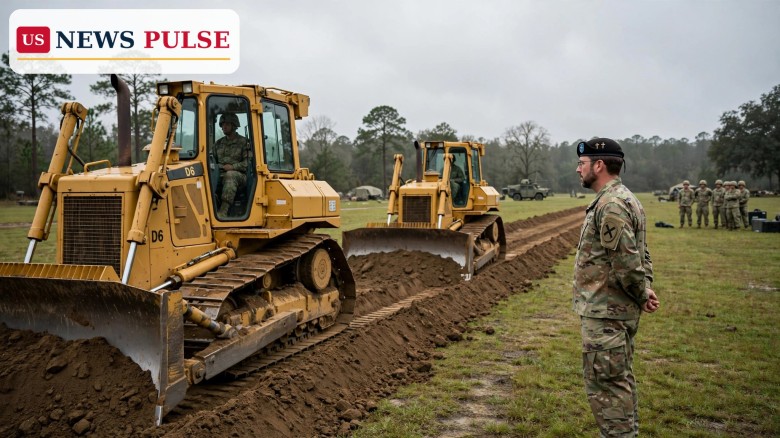
In a Fort Bragg mass burial drill this autumn, United States Army engineers dug mass graves for fallen soldiers in the first large-scale battlefield burial exercise since the Korean War, practising a grim skill the service had let lapse for more than 70 years. In Operation Dragon Covenant, held on October 20 and 21 near the St. Mere Eglise Drop Zone in North Carolina, bulldozer crews, excavators and about 130 military chaplains rehearsed digging, filling and marking temporary graves. Army planners say one engineer company could prepare and close trenches for up to 2,400 fatalities in 24 hours.
Key Points
- Operation Dragon Covenant ran October 20-21, 2026, at Fort Bragg, the first such exercise at scale since the 1950-53 Korean War.
- One D6 crew dug a trench for 20 casualties in about one hour and 15 minutes; one engineer company could handle up to 2,400 fatalities in 24 hours.
- About 130 chaplains took part, the first such training in 20 years.
- Findings go to the Joint Mortuary Affairs Center for a revision of Army fatality-management policy; a third phase is planned for spring 2027.
- Reuters frames the publicised drill as Pentagon signalling of readiness for a high-intensity war with China or Russia.
What Happened
In late October, soldiers from the 3rd Corps Sustainment Command, the 20th Engineer Brigade and Unit Ministry Teams across the 18th Airborne Corps gathered near the St. Mere Eglise Drop Zone at Fort Bragg for an exercise not attempted at this scale since the early 1950s. The 27th Engineer Battalion used D6 bulldozers to cut long, straight trenches, while chaplains practised the religious rites of battlefield burial.
The pace was the point. One crew completed a trench for 20 casualties in about one hour and 15 minutes. Planners calculated that one engineer company, with eight bulldozers and four High Mobility Engineer Excavators working continuously, could prepare and close trenches for up to 2,400 fatalities every 24 hours, more than the 2,354 deaths the Pentagon attributes to the whole of America's post-September 11, 2001 war in Afghanistan. Simulated skeletal models and sealed water containers stood in for remains, testing whether backfilling would crush them; a standard plot is five parallel trenches holding 100 casualties. Reuters examined the drill in a commentary published on Thursday, November 26.
Background: Why the Army Stopped Practising Burials
Temporary battlefield burial, known as temporary interment, was once routine. In the Korean War of 1950-53, American dead were often buried in hasty battlefield cemeteries before being exhumed and returned home, The practice faded in later wars: in Vietnam, the Gulf, Iraq and Afghanistan, US air superiority and a vast evacuation chain meant the dead were flown home quickly.
That assumption no longer holds. A war with China over Taiwan, or with Russia in Europe, would be fought against an enemy able to strike airfields, ports and ships and contest the skies for weeks. Casualties would arrive in waves, and the aircraft and ships needed to bring the dead home might be busy, damaged or destroyed.
The timing is shaped by the war with Iran: Operation EPIC FURY, the American campaign against Iran since late February 2026, has significantly depleted US stocks of long-range-strike and air-defence missiles, according to Reuters. The drill sits inside a wider readiness push: the Navy has just stood up a new maritime squadron for SEAL Team Six, the Army has fielded its first Dark Eagle hypersonic missile battery after a $12 billion build, and engineers in Iowa have been clearing decades-old explosives from an Army ammunition plant.
The Fort Bragg Mass Burial Drill: Inside Operation Dragon Covenant
Operation Dragon Covenant was built around two problems: speed and dignity. Trenches must be deep enough to protect remains, wide enough for orderly placement, and backfilled without crushing them, while the unit doing the work may itself be under threat. Tests proved the backfill would hold, and the five-trench, 100-casualty plot gives commanders a standard layout to replicate anywhere.
The second problem is harder. About 130 religious support personnel took part, the first time in 20 years Army chaplains have trained on religious support for temporary battlefield interment. Their role is to ensure that even a burial at wartime speed honours the dead, with the right prayers and records precise enough that a temporary grave can be found again.
Reactions
The most striking reaction is the Army's own decision to talk about it. Militaries rarely publicise plans for handling mass casualties, and the Army's detailed account of trench sizes and timings reads as a deliberate message, not a routine press release. Reuters treated it that way, framing the drill as Pentagon signalling about readiness for a high-intensity war with China or Russia.
The signalling cuts two ways. To allies, the exercise says the United States is thinking seriously about what a major war would cost and is preparing its institutions, not just its weapons. To adversaries, it says the Pentagon expects losses in the thousands in a single day, and plans to absorb them and keep fighting. The findings now go to the Joint Mortuary Affairs Center for a revision of Army fatality-management policy.
Why It Matters
The drill matters first because of what the numbers mean. A capacity of 2,400 burials a day is not a figure for a counter-insurgency or a peacekeeping mission. It is a figure for a war against a peer enemy, in which a single bad day can kill more Americans than the entire Afghanistan war.
It matters second because it reveals a gap the Pentagon is only now closing. For seven decades the United States brought its dead home quickly, and the skill of burying them on the battlefield withered. Rebuilding it now, in public, tells the public, allies and adversaries that the government no longer assumes the next war will look like the last. The Navy's new SEAL Team Six maritime squadron points the same way.
What Happens Next
The findings go to the Joint Mortuary Affairs Center to revise Army fatality-management policy. A third phase is planned for spring 2027, under daytime and blackout conditions, testing whether the procedures work when crews cannot use lights.
Watch whether the other services follow: the Marine Corps, Navy and Air Force face the same problem, and a public Army exercise often precedes similar announcements from them. The details of the policy revision will show how seriously the Pentagon takes the prospect of war on that scale.
Frequently Asked Questions
What is Operation Dragon Covenant?
A US Army exercise held October 20-21, 2026, at Fort Bragg, in which engineers, sustainment troops and chaplains practised temporary battlefield burial, the first such exercise at scale since the Korean War.
Why is the Army practising mass burials now?
Because a high-intensity war with China or Russia could produce casualties faster than the evacuation system built for Iraq and Afghanistan could handle.
How many war dead could the Army bury in a day?
Up to 2,400, using one engineer company with eight bulldozers and four excavators working continuously.
When did the US military last do this at scale?
During the Korean War of 1950-53, when American dead were buried in temporary battlefield cemeteries before being exhumed and returned home.

The US News Pulse newsroom covers breaking news across the United States and the world, working from wire services, official statements and on-the-record sources. Every story is reviewed against our editorial standards before publication. Corrections and tips: info@usnewspulse.com
About our newsroomLeave a Comment