


 | Today's Date:



Democrats Push Energy Permitting Bill in Lame-Duck Session Despite Weaker Odds
WASHINGTON — The Democratic architects of the energy permitting bill said Wednesday they will not wait for a friendlier Congress. Instead of holding the Bipartisan American Affordability and Jobs Act until Democrats take control of both chambers next year, Senators Martin Heinrich and Sheldon Whitehouse, who negotiated it with Republicans Shelley Moore Capito and Mike Lee, said they will push it through the post-election lame-duck session, even as analysts lowered its chances of becoming law. The decision sets up one of the final legislative fights of the current Congress, pitting a bipartisan deal years in the making against a Democratic Party newly emboldened by a sweeping midterm victory — and against environmental groups and lawmakers who believe waiting would produce a stronger bill.
Key Points
- Senators Martin Heinrich and Sheldon Whitehouse said November 4 they will push the energy permitting bill in the lame-duck session rather than wait for the new Congress.
- The Bipartisan American Affordability and Jobs Act aims to speed construction of transmission lines, mines and energy projects, both renewable and fossil-fuel.
- Heinrich said it is the closest lawmakers have come to a deal that can be signed into law, while Whitehouse called it “a bird in the hand.”
- Investment firm TD Cowen cut its outlook for the bill’s success from about 40 percent to about 25 percent after the Democrats’ midterm victory.
- Some Democrats, including Representative Jared Huffman, and environmental groups argue a Democratic Congress could pass more ambitious legislation.
What Happened
Speaking to Reuters on Wednesday, November 4, 2026, Heinrich of New Mexico said he would not delay the bill in hopes of a better deal next year. “This is the closest we have come to actually finding something that can get signed into law, and I’m not going to wait,” he said. Whitehouse of Rhode Island was blunter still: “It’s a bird in the hand. We’d be fools not to take it.”
The remarks came one day after Democrats swept the midterms, a result that will hand them control of both chambers in January. But with a Democratic majority in sight, some in the party see little reason to accept a Republican-negotiated compromise, and TD Cowen said the victory “likely emboldens voices arguing bill gives too many concessions to (oil and gas).”
Background: Years of Work on Permitting Reform
Permitting reform has been one of Washington’s longest-running unfinished projects. Energy developers of nearly every stripe — wind and solar companies, mining firms, pipeline builders and grid operators — have complained for years that federal reviews, lawsuits and overlapping agency approvals can delay projects for a decade or more.
The Bipartisan American Affordability and Jobs Act is the culmination of years of that work. It seeks to accelerate approvals for transmission lines, mines and energy projects of both kinds: renewable projects such as wind and solar, and fossil-fuel projects such as oil and gas drilling and pipelines. That breadth is the source of both its bipartisan appeal and its internal tension. Each side gets something it wants, and each side gives up something it would rather keep.
Energy Permitting Bill: What It Would Change
At its core, the bill would shorten and streamline the federal permitting process for major energy infrastructure. Transmission lines — the high-voltage arteries that carry electricity from wind farms, solar plants and power stations to cities — are a central focus, because grid bottlenecks are now widely seen as the biggest obstacle to new power generation of any kind. Mines for the minerals used in batteries, electric vehicles and electronics would also see faster reviews.
For supporters, the payoff is practical: cheaper energy, more construction jobs and a grid better able to handle rising electricity demand from data centres, factories and electrified transport. The bill’s title ties permitting directly to household energy costs and jobs.
Reactions and Quotes
Reaction on Wednesday split along the fault line the authors acknowledged. Heinrich framed the choice as timing versus certainty: a deal that can be signed now against a hypothetical deal later.
TD Cowen’s downgrade gave the sceptics a number. Cutting the bill’s estimated chance of success from about 40 percent to about 25 percent, the firm tied the shift directly to the election outcome, arguing that a sweeping Democratic victory changes the incentives of the very lawmakers whose votes the bill needs.
Why It Matters
The fight matters well beyond Capitol Hill procedure because permitting timelines shape what gets built in America, and how fast. A transmission line approved in two years rather than ten can decide whether a wind project gets financed; a mine permitted on schedule can mean a more secure domestic mineral supply.
It also matters as a test of what the Democratic victory actually changes. Winning Congress does not automatically produce legislation: the party’s own divisions over energy — between climate-focused progressives and deal-making pragmatists — will shape what, if anything, reaches the president’s desk. The permitting bill is the first place those divisions are being fought out in public, and its fate may preview the new Congress’s broader legislative agenda.
What Happens Next
The immediate question is whether Senate leaders schedule floor time for the bill before the session ends. Lame-duck calendars are crowded, and must-pass spending and defence legislation traditionally takes priority. The bill’s authors will need to demonstrate that their bipartisan agreement can still command the votes — including Republican votes — to clear procedural hurdles.
If it stalls, the bill does not necessarily die. Its authors could reintroduce it in the new Congress, where Democratic majorities would change the negotiating dynamic entirely — but also raise the question Huffman and others are already asking: why settle for a compromise when a stronger bill might pass? If it moves, it would become one of the most significant energy laws in years, and a rare bipartisan achievement in a polarised era.
Frequently Asked Questions
What is the Bipartisan American Affordability and Jobs Act? A bipartisan energy permitting bill to speed federal approvals for transmission lines, mines and energy projects, renewable and fossil-fuel alike.
Why push it now instead of waiting? Authors Heinrich and Whitehouse say it is the closest they have come to a deal that can be signed into law, and they do not want to risk losing it.
What are its chances? TD Cowen cut its outlook from about 40 percent to about 25 percent after the midterm victory, citing pressure from those who say it concedes too much to oil and gas.
Who prefers to wait? Some Democrats, including Representative Jared Huffman, and environmental groups argue a Democratic Congress could pass more ambitious legislation.
What happens next? The bill needs floor time and bipartisan votes in the lame-duck session; if it stalls, it could be reintroduced in the new Congress.
Related coverage: Democrats plan flood of Trump probes if they retake House, report says; Democratic wins would shift Trump tariff debate but not repeal tariffs; Cook Political Report shifts 14 races toward Democrats before midterms.
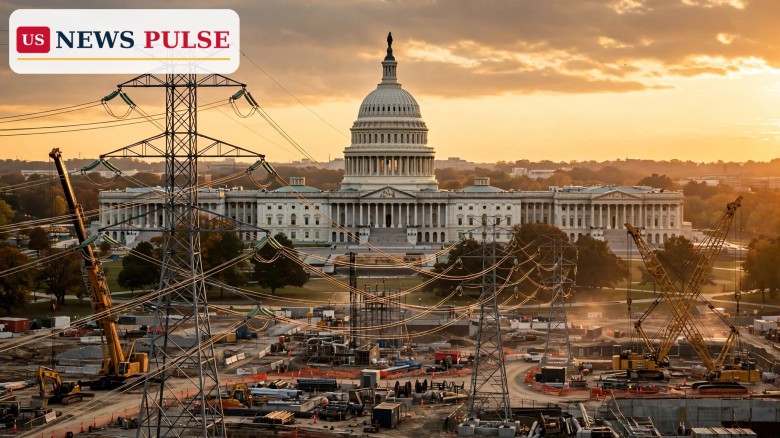
Image: US Capitol with transmission lines and energy construction. Alt: US Capitol with high-voltage transmission lines and energy construction at sunset.
Leave a Comment