


 | Today's Date:


Trump Takes California Ballot Fight to Supreme Court on Election Eve 2026
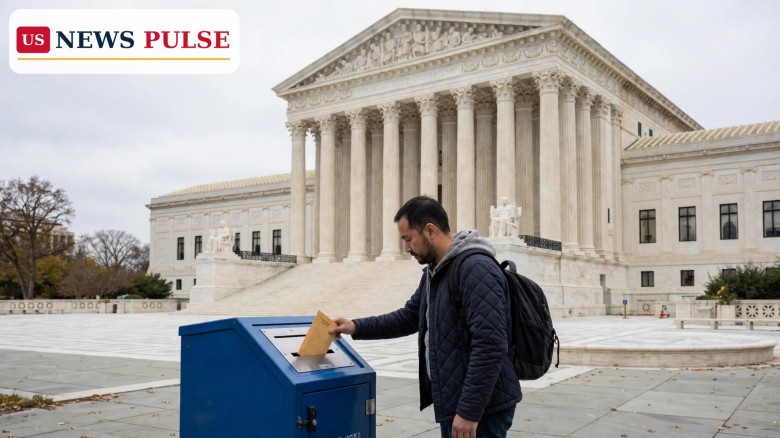
The Trump administration asked the United States Supreme Court on Monday, November 2, 2026, to temporarily block California from counting mail-in ballots cast by more than 20,000 registered voters whom federal officials allege are likely not United States citizens. The emergency filing landed one day before the November 3 midterm elections, in which control of Congress for the final two years of President Donald Trump's second term will be decided.
The Justice Department wants the justices to order California to separate any ballots cast by people on the federal list from other ballots, and not to count them until each voter's citizenship status can be verified. In its filing, the department warned that once challenged ballots are counted and mixed with lawful votes, the damage cannot be undone.
"Once illegally cast ballots are counted and commingled with lawful votes, the resulting harm is impossible to remedy," the Justice Department wrote, according to Reuters and USA Today.
California has pushed back forcefully. State officials say California already has robust safeguards against noncitizen voting, that the federal process used to build the list is flawed and likely riddled with errors, and that the lawsuit threatens to deprive 20,000 people of their right to vote on the basis of vague accusations. The dispute now sits with a court that has already intervened twice in election-related fights this autumn, and that must weigh any action against the very short time left before voting ends.
Key Points
- The Trump administration filed an emergency request with the Supreme Court on November 2, 2026, seeking to set aside California mail ballots from more than 20,000 voters it alleges may not be citizens.
- The Justice Department wants those ballots separated and held uncounted until each voter's citizenship is verified, warning that commingled ballots cannot later be retrieved.
- A federal judge in Los Angeles rejected the request on October 28, and the 9th US Circuit Court of Appeals refused it on Friday, October 30, in a 2-1 decision.
- California says its safeguards are robust and the federal list is highly suspect, while the administration says the state is blocking enforcement of a 1996 law barring noncitizen voting in federal elections.
- The case arrives on the eve of the November 3 midterms, when all 435 House seats and 35 Senate seats are at stake, and California alone holds 52 House seats.
What Happened
The filing escalates a legal fight that began on October 15, when the Justice Department sued California in federal court. The department claimed the state was unlawfully preventing enforcement of a 1996 federal law that makes it a criminal offence for noncitizens to vote in federal elections. It argued that California's position violated the Constitution's Supremacy Clause, under which federal law generally overrides conflicting state law.
The list at the centre of the case was assembled by the Department of Homeland Security and sent to California officials and to Los Angeles County officials. Federal officials say the people on it are likely noncitizens who appear on the voter rolls. California disputes that characterisation, and the courts below found the government's evidence wanting.
US District Judge David Carter in Los Angeles denied the administration's request for emergency relief on October 28. His language was unusually blunt. "Never before in American history has the federal government, on the eve of an election, sought to coerce a state and local government to abandon their own constitutional elections procedures and bend to the will of the executive branch," Carter wrote.
Carter also raised doubts about the reliability of the data itself. He noted that people recently flagged by the federal government as noncitizens on voter rolls in other states have repeatedly turned out to be naturalised US citizens. He added that the administration had failed to provide sufficient evidence that it used a credible process to create the list. "If the executive can discount votes and threaten an ongoing election due to unproven allegations, then our democracy is in danger," he wrote.
The San Francisco-based 9th Circuit refused to intervene on Friday. Its majority emphasised the state's power over election procedures and California's comprehensive statutory scheme to ensure the integrity of its elections, including a system for cancelling registrations if a voter is shown to be ineligible. Forcing California to use the federal list, the court said, could bar valid votes from being cast and jeopardise the Los Angeles County election. "As the district court found — and we discern no clear error — there is no feasible way to identify and segregate the ballots of specific individuals without potentially catastrophic effects on the entire system," the appeals court said.
Circuit Judge Patrick Bumatay dissented. He called the government's request reasonable, writing: "This solution would not cancel any vote but would allow time to verify the eligibility of suspected noncitizens." The administration then took that dissenting logic, and the majority's warning, to the Supreme Court on Monday.
Background and Context
The California case does not stand alone. It is part of a broader, increasingly aggressive federal approach to how states run elections in the final days of the midterm campaign. The Justice Department has told election officials in all 50 states that they could face criminal prosecution if they knowingly allow noncitizens to remain on their rolls or cast ballots. It has also lost a series of lawsuits seeking to obtain voter rolls, including sensitive personal information, from dozens of states.
The administration had already sought to restrict voting by mail, a method used more often by Democratic-leaning voters, but the Supreme Court in September rebuffed that effort. In the same month, the justices barred Missouri from using a redrawn map of its House districts designed to favour Republicans in the midterms, warning that reinstating that map in the midst of an ongoing election would usher in electoral chaos. That history matters now, because the California request also asks the court to act while voting is already under way and millions of ballots have already been cast.
Trump has made false claims about widespread voting fraud, including in the 2020 election he lost to Democrat Joe Biden. Multiple studies and state audits show that ineligible voting, including by noncitizens, is rare. A Reuters investigation published in July found just 129 cases in which noncitizens had been charged with voting illegally since the 1996 law criminalising such conduct took effect. Many of those cases appeared to stem from voter confusion or administrative errors, rather than intentional fraud.
California's size gives the case national weight beyond its legal questions. California is the most populous US state and a Democratic stronghold, with 52 seats in the House of Representatives, more than any other state. Democrats need a net gain of four House seats to win a majority in the chamber. Republicans, meanwhile, are fighting to retain control of Congress, and Trump has made California a focal point of his sweeping immigration crackdown. Even a ruling that affects only a small number of ballots in one state would therefore carry a political signal far larger than the numbers involved.
The constitutional argument at the heart of the case is familiar, but the timing is not. The Constitution assigns the responsibility for administering elections to states, though the federal government retains some oversight. The lawsuit marked a rare federal intervention in the voting process and signalled a willingness by the administration to contest election results in court. California's response, in court papers, was that the process the administration used to create its list is highly suspect, and that the state already has safeguards to protect election integrity.
California Ballot Fight: Why the Supreme Court's Timing Matters
The Supreme Court's review of the emergency request could take into account the short time frame before Election Day, Reuters reported. That is not a technical point. Emergency applications to the court are often decided quickly and without full briefing or oral argument, and a decision to segregate ballots would have to be implemented by county election officials who are already counting, verifying and reporting votes.
The lower courts' reasoning focused heavily on practicality. Identifying and pulling aside the ballots of specific individuals, after ballots have been mailed, returned and in many cases already processed, is not a simple sorting exercise, the 9th Circuit majority argued. Mail ballots are designed to protect voter secrecy, and once a ballot envelope is separated from its contents, linking a vote back to a name becomes difficult by design. That is why the administration's warning about commingling cuts both ways: the government says uncounted separation is the only safe course, while the courts below said forced separation risks breaking a system that is already running.
There is also a second, parallel fight over the Justice Department's broader election pressure campaign. A federal judge in San Francisco has separately barred the Justice Department and the Department of Homeland Security from threatening election officials with prosecution for processing ballots of voters the government claims are ineligible, in an order reported on November 2. That order, and the California case, together describe a campaign in which the courts are being asked, repeatedly and at speed, to draw the line between federal enforcement and state-run elections.
For voters, the immediate practical question is narrower: will any ballot cast by a person on the federal list be counted on Tuesday? As of Monday, the answer remained the one given by the lower courts — yes, unless the Supreme Court orders otherwise. The justices have given no timetable, and emergency requests can be granted, denied, or held without explanation. What is certain is that California election officials, and voters in Los Angeles County in particular, will be watching for an order that could arrive at any hour before polls close.
Reactions and Quotes
The Justice Department's core argument is about irreversibility. "Once California commingles the challenged ballots with lawful ones, there is no way to get the challenged ballots back," it wrote in its appeal, according to USA Today. That framing presents segregation not as disenfranchisement, but as preservation: hold the disputed ballots aside, verify them, and count only those that prove valid.
Judge Carter's response rejected that framing outright. Beyond his warning about coercion, he questioned whether the list itself could be trusted, pointing to past cases in which flagged voters turned out to be naturalised citizens. His conclusion — that discounting votes on unproven allegations endangers democracy — has become the most quoted passage in the case, and it is likely to feature in California's response to the Supreme Court.
The 9th Circuit majority added an institutional concern: that siding with the administration could result in disenfranchisement and could jeopardise the county's entire election. Judge Bumatay's dissent offered the counterpoint that will anchor the government's Supreme Court brief — that segregation would not cancel any vote, but would simply buy time to verify eligibility.
California's own position, as stated in court papers and summarised by Reuters, is that its safeguards are robust and the lawsuit threatens to deprive 20,000 people of their right to vote based on vague accusations. The state has also argued that the federal scrutiny process is flawed and likely rife with errors, a claim the district court found persuasive enough to deny emergency relief.
No statement from the Supreme Court had been reported at the time of publication, and the court does not ordinarily explain emergency orders in full. The absence of a ruling on Monday morning therefore told voters little, except that the case was now in the justices' hands with hours, not weeks, to run.
Why It Matters
The case matters first because it tests, on the eve of a national election, how far the federal government can go in directing a state's ballot-counting process. If the Supreme Court grants the request, it would mark a significant federal intervention in a state election, and it would establish that a federal list, assembled without the state's agreement, can force segregation of ballots even after lower courts found the evidence unreliable. If the court denies it, the lower courts' emphasis on state control and practical administrability will stand, at least for this election.
It matters second because of the precedent for future elections. Emergency orders are often cited in later cases, and a ruling here — in either direction — will shape how the Justice Department, the Department of Homeland Security and state officials approach voter-roll disputes in 2028 and beyond. A grant would encourage similar federal challenges in other states; a denial would signal that courts will demand stronger evidence before disrupting an election already in progress.
It matters third for public confidence. Noncitizen voting is rare, according to studies and audits, yet the allegation alone can sow doubt. A court order to set ballots aside could be read by some voters as confirmation that something was wrong, while a refusal to intervene could be read by others as indifference to the law. Either way, the case shows how election administration, once a largely technical subject, has become a central battleground in American politics.
What Happens Next
The Supreme Court could act at any time before, or even after, polls close on Tuesday. If it grants the administration's request, California and Los Angeles County would be ordered to separate ballots cast by people on the federal list and hold them uncounted pending verification of citizenship. That would trigger an urgent scramble by county officials to identify those ballots without disrupting the count of millions of others.
If the court denies the request, or declines to act before the election, California will count the ballots under its existing procedures, and the underlying lawsuit will continue through the ordinary courts after the midterms. The Justice Department's October 15 suit, and the question of whether California is unlawfully blocking enforcement of the 1996 law, would not disappear with a denied emergency application.
Trump is also due to deliver his closing midterm message on Monday afternoon at the Reflecting Pool in Washington, capping a final campaign blitz in Iowa and Kansas. That speech, and Tuesday's results, will determine whether the California fight is remembered as a last-minute legal skirmish or as the opening move in a longer post-election contest over the results. For now, the only certainty is the calendar: voters go to the polls on Tuesday, November 3, and the Supreme Court holds a request that could still change how some of their ballots are treated.
Frequently Asked Questions
What did the Trump administration ask the Supreme Court to do?
It asked the justices to temporarily block California from counting mail-in ballots from more than 20,000 registered voters it alleges are likely noncitizens, by ordering the state to separate those ballots and hold them uncounted until citizenship is verified.
Why did lower courts refuse the same request?
Judge David Carter denied it on October 28, questioning the reliability of the federal list and warning against coercing a state on the eve of an election. The 9th Circuit refused it on Friday, saying there was no feasible way to segregate the ballots without potentially catastrophic effects on the Los Angeles County election.
How rare is noncitizen voting?
Multiple studies and state audits show it is rare. A Reuters investigation published in July found just 129 cases in which noncitizens had been charged with voting illegally since the 1996 law criminalising such conduct took effect.
Does the case affect the whole midterm election?
Directly, it concerns ballots in California, which holds 52 House seats. Democrats need a net gain of four House seats for a majority. Politically, however, any Supreme Court action would signal how far federal intervention in state elections can go.
When will the Supreme Court decide?
No timetable has been reported. Emergency requests can be decided at any time, with or without a full explanation, and the court could act before or after polls close on Tuesday, November 3.
Related coverage on US News Pulse: Democrat Haley Stevens endorses Republican Mike Rogers in Michigan Senate race, Trump says he will become Mr Veto if Democrats win Congress in midterms, and Alaska calls Trump ballot demand impossible in Saturday court filing. The featured image is an illustrative generated scene, not an actual photograph from the Supreme Court or a California ballot drop box.
Leave a Comment