


 | Today's Date:




Scientists Find Dinosaur Blood Traces in 115-Million-Year-Old Fossil in World First
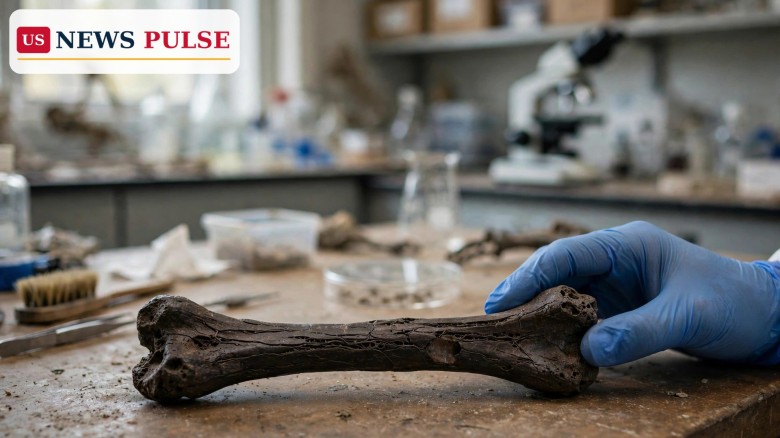
Scientists say they have found the strongest evidence yet of blood in a dinosaur fossil — microscopic structures that look like red blood cells, and chemical traces of the molecule that carries oxygen in blood, preserved inside a 115-million-year-old leg bone from Brazil. It is, the researchers say, the first direct molecular evidence of blood compounds in a dinosaur fossil. Not every expert is convinced.
The discovery was published on Monday, November 2, 2026, in the journal Proceedings of the National Academy of Sciences. It comes from an international team led by Curtin University geochemist Kliti Grice, who examined the right leg bone of a juvenile Aratasaurus museunacionali, a bipedal meat-eating dinosaur about 10 feet (3.1 metres) long that lived in what is now north-eastern Brazil during the Cretaceous Period.
Key Points
- Researchers found microscopic structures inside the leg bone of a juvenile Aratasaurus that appear to be fossilised red blood cells, about 23 micrometres long and 20 micrometres wide.
- Chemical tests also detected heme, the iron-containing molecule in haemoglobin that carries oxygen in blood, including heme B and an altered form, 3,8-diethyl heme B, inside the bone's vascular canals.
- The structures were preserved with hausmannite, a manganese oxide mineral, and the team also found hydroxyproline, an amino acid linked to collagen.
- The fossil was unearthed in 2008 in a gypsum mine in Ceará state, north-eastern Brazil, and was first mistaken for a pterosaur.
- Not all experts accept the finding: molecular palaeontologist Mary Schweitzer disputes the identification, and tests for ancient DNA came back negative, so cloning is not possible.
What Happened
Using microscopy and chemical analysis, the team looked inside the vascular canals of the fossil bone — the tiny channels that once carried blood vessels through the living animal. There they found disc-shaped structures of the size and form expected of red blood cells, preserved in remarkable detail after 115 million years. The structures measure about 23 micrometres long and 20 micrometres wide.
The chemical evidence is what the researchers say sets this find apart. Tests detected heme B and an altered form, 3,8-diethyl heme B, in the same canals. Heme is the iron-containing part of haemoglobin, the protein that carries oxygen through the blood of vertebrates — the first direct molecular evidence, the team argues, that blood compounds can survive in a fossil of this age.
Background: A Bone Mistaken for a Pterosaur
The fossil itself has an unusual history. It was unearthed in 2008 in a gypsum mine in Ceará state, in north-eastern Brazil, and was first mistaken for a pterosaur, the flying reptile of the same era. Later study identified it as Aratasaurus museunacionali, a theropod dinosaur — a two-legged meat-eater — and the specimen is a juvenile, about 10 feet long, from the Cretaceous Period.
Blood and other soft tissues almost never survive fossilisation. Flesh decays quickly, and only hard parts such as bone and teeth normally remain. That is why claims of preserved dinosaur tissue are treated with such care — and why this study pairs the shapes seen under the microscope with chemical traces of the molecules themselves.
Dinosaur Blood: What the Fossil Really Shows
The case rests on two lines of evidence found together in the same place. First, the microscopic structures inside the bone's vascular canals resemble red blood cells in size and shape. Second, chemical tests found heme molecules in those same canals — the very compounds that would have been present in the blood flowing through them when the animal was alive. The structures were preserved alongside hausmannite, a manganese oxide mineral that appears to have helped lock the delicate remains in place, and the team also detected hydroxyproline, an amino acid associated with collagen.
Just as important is what the fossil does not show. There is no liquid blood, no intact blood vessels and no dinosaur DNA. Tests for ancient DNA came back negative, which means there is no prospect of cloning the animal, whatever films may suggest. Lead researcher Kliti Grice put it plainly: "We have not found a vial of dinosaur blood. What we are seeing is a mineral and molecular echo of ancient biology."
Reactions and Quotes
Grice's caution reflects how the team itself frames the find: not a jar of Jurassic blood, but the chemical and structural shadow of blood, preserved by minerals over 115 million years. The study went through peer review at Proceedings of the National Academy of Sciences before publication on November 2.
But the scepticism arrived quickly. Molecular palaeontologist Mary Schweitzer of North Carolina State University disputes the identification. She points to the structures' shape and size, and to the absence of a nuclear bulge — the swelling where the cell nucleus sits. Like birds, dinosaurs are thought to have had nucleated red blood cells, so a genuine dinosaur red blood cell should show that bulge. Schweitzer argues the structures could be mineral formations that mimic the shape of cells.
That disagreement is normal in palaeontology, where extraordinary claims are tested in public and in print, and other laboratories will now examine the evidence.
Why It Matters
If the identification holds up, the find opens a new window into dinosaur biology. Blood chemistry could one day reveal details of how dinosaurs lived and grew, and feed into the long-running debate over whether dinosaurs were warm-blooded like birds or cold-blooded like modern reptiles. It would also show delicate biological molecules can survive 115 million years when the mineral conditions are right. Even if the sceptics are right, the study raises the standard for claims about ancient soft tissue by showing exactly what evidence is needed — structures and molecules, found together, where blood once flowed.
What Happens Next
Other laboratories are expected to try to replicate the result, testing the same bone and other fossils from the same Brazilian deposits. The team will also face detailed questions about whether the heme could have come from contamination or later processes rather than from the dinosaur itself. If independent tests confirm it, researchers will search for the same molecular signature in other well-preserved specimens.
Frequently Asked Questions
Did scientists really find dinosaur blood?
Not liquid blood. They found fossilised structures that look like red blood cells, plus chemical traces of heme, the oxygen-carrying molecule in blood, inside a 115-million-year-old dinosaur leg bone.
What dinosaur was it?
A juvenile Aratasaurus museunacionali, a bipedal meat-eating theropod about 10 feet (3.1 metres) long, from Cretaceous-era Brazil.
How old is the fossil?
About 115 million years old. The bone was unearthed in 2008 in a gypsum mine in Ceará state, north-eastern Brazil.
Could this lead to cloning a dinosaur?
No. Tests for ancient DNA came back negative, and there is no intact genetic material to work with.
Why do some scientists disagree?
Molecular palaeontologist Mary Schweitzer argues the structures' shape and size do not match red blood cells, and notes the lack of a nuclear bulge that a dinosaur red blood cell should have.
Read more in our science coverage: Nanotyrannus fossil sells for $47.3 million at Sotheby's and NASA Mars simulation crew emerges after 378 days inside Houston habitat.
Leave a Comment