


 | Today's Date:



Carlson Claims Trump May Be Days From Nuclear Strike on Iran's Pickaxe Site
Tucker Carlson nuclear Iran claim exploded across social media on Monday, November 2, 2026, when the conservative commentator wrote that the Trump administration "may be within days of launching a nuclear strike on Iran" — a claim that neither the White House nor Israel has confirmed, and one that sits in direct tension with President Donald Trump's own public ruling-out of nuclear weapons against Iran in October.
Carlson, writing in a long post on X early on November 2, identified Pickaxe Mountain in central Iran as the supposed target. He alleged that Israeli Prime Minister Benjamin Netanyahu is pressing Trump to authorise the strike, that conventional weapons cannot penetrate the site's roughly 300 feet of granite, and that Trump could decide by November 7 whether to use nuclear weapons. Within hours, the post had passed 16 million views, according to reports tracking it, and it was picked up by outlets including Haaretz, The Express Tribune, Siasat and Army Recognition.
Nothing in Carlson's post is, on its own, proof that such a strike is planned. He cited no documents and relied on an unnamed "informed observer". The White House and Netanyahu's office declined to comment on the related Trump-Netanyahu call reported by Axios, and no official statement has confirmed that nuclear weapons are under consideration. That distinction — between a widely shared claim and a confirmed decision — is the most important fact in this story.
Key Points
- Tucker Carlson claimed on X early on November 2, 2026, that the Trump administration "may be within days of launching a nuclear strike on Iran" at Pickaxe Mountain.
- Carlson alleged Netanyahu is pressing Trump daily for the strike, and said Trump could decide by November 7 — while also writing that Trump is hesitating.
- Neither the White House nor Israel has confirmed Carlson's claims, and Carlson cited no documents, relying on an unnamed "informed observer".
- Trump told Newsmax on October 15 that he would not use nuclear weapons against Iran, saying: "No, I wouldn't use nuclear. We don't have to."
- Secretary of State Marco Rubio said on October 31 that Trump had not made a decision on further strikes against Iran and preferred a diplomatic solution.
- Pickaxe Mountain, also called Kuh-e Kolang Gaz La, sits about two kilometres south of Iran's Natanz enrichment plant, and independent analysts say there is no confirmation that enrichment is taking place inside it.
What Happened
Carlson's post landed in the middle of a weekend of contradictory signals about Iran. On Saturday, October 31, Trump told reporters that the United States still had to "take care" of one or two Iranian nuclear sites, adding: "We can do that in 10 minutes. We have that planned. You can look at Pickaxe Mountain. We need to take care of that. We can do that very quickly." The same day, Rubio told reporters at the G20 foreign ministers' meeting in Atlanta, Georgia, that Trump "hasn't made a decision" on further military action and that the president preferred a diplomatic solution.
Axios, citing one Israeli and one U.S. source, reported that Trump and Netanyahu had a "tough" call on Saturday, with Netanyahu pressing for a strike right after Tuesday's U.S. midterm elections while Trump wanted negotiations to play out. Trump later described the conversation publicly as a "very good talk" and said they had discussed Iran. The White House and Netanyahu's office declined to comment on the call itself, according to Clash Report's account of the Axios reporting.
Carlson's post then reframed that disagreement as a nuclear question. He wrote that Netanyahu "has been pushing hard for one" — meaning a nuclear strike — and quoted his unnamed source as saying: "Bibi calls Trump about it every day." He argued that the tunnels at Pickaxe Mountain lie beneath about 300 feet of solid granite, beyond the reach of conventional American weapons, and concluded: "The only military option is a nuclear strike." He also claimed Netanyahu had lobbied Defence Secretary Pete Hegseth and CENTCOM commander Brad Cooper to resume major combat operations, and named Rubio and CIA Director John Ratcliffe as officials allegedly following Netanyahu's lead.
At the same time, Carlson wrote that Trump was listening to a different camp inside his administration. Vice President JD Vance and special envoy Steve Witkoff, Carlson wrote, are arguing that a deal with Iran can be made. "To his credit, he's hesitating," Carlson wrote of Trump, in a line that cuts against the alarm of his own headline claim. That hesitation, if accurate, is consistent with Rubio's public position on Saturday and with Trump's own October statement ruling out nuclear use.
Background and Context
The claim cannot be understood without the war that preceded it. The United States and Israel launched military strikes against Iran on February 28, 2026, prompting Iranian retaliation against Israel and U.S. targets across the region. A ceasefire was reached in April. On June 18, the United States and Iran signed a memorandum of understanding on freedom of navigation in the Strait of Hormuz, but its implementation stalled amid disagreements over security arrangements.
Since then, the Strait of Hormuz has remained the most dangerous pressure point in the confrontation. Iranian state media reported on November 1 that two oil tankers had exploded after hitting mines on an unauthorised route through the strait, and commercial shipping in the Gulf has faced repeated attacks and disruption through October. Carlson himself noted the shipping toll, writing that supertankers had been badly damaged in Hormuz in October, and warning that continued attacks could deepen disruption to global oil and fertiliser markets.
Diplomacy has run in parallel with the threats. Qatari mediators held discussions with Iranian officials for a third consecutive day on Sunday, November 1, to facilitate an agreement that could pave the way for direct talks. Reuters reported on November 2 that Iranian negotiators had left talks with Qatari mediators in Doha and that a draft proposal was being circulated, with a follow-up meeting possible. Iran's foreign ministry spokesperson, Esmaeil Baghaei, said the basis of the talks is a seven-step plan Iran drew up in September to reopen the Strait of Hormuz and end the U.S. naval blockade, and that Tehran now suggests that proposal could be implemented on a faster timeline. Foreign Minister Abbas Araghchi told Al Jazeera on Saturday that under a deal, Hormuz could be opened within a two-day timeline rather than the seven days originally envisaged.
Pickaxe Mountain itself has been a focus of military analysis for years. The Center for Strategic and International Studies identifies it as Kuh-e Kolang Gaz La, a tunnel complex about two kilometres south of the Natanz enrichment plant. The Institute for Science and International Security (ISIS) says construction began in the fall of 2020 and estimates the facility sits at least 100 metres deep — close to the 300 feet Carlson cited. Crucially, ISIS imagery from October 7 showed the eastern tunnel entrances still blocked by earth, which its analysts said suggests the site is neither operational nor under major construction. There is, in other words, no independent confirmation that uranium enrichment is taking place inside the mountain, even though Israeli intelligence reportedly believes enrichment equipment has been moved into the complex.
On the conventional side, the principal American weapon for deeply buried targets is the GBU-57 Massive Ordnance Penetrator, a GPS-guided bomb weighing approximately 13,600 kilograms, delivered by the B-2 Spirit stealth bomber. U.S. forces previously employed it against Iranian nuclear facilities during Operation Midnight Hammer in June 2025, although its effectiveness against the deeper sections of Pickaxe Mountain remains uncertain. The United States also possesses the B61-11 earth-penetrating gravity bomb, designed to penetrate the ground before detonation. Its existence does not establish that such a weapon is being considered against Iran — a point Army Recognition stressed in its own analysis of Carlson's claims.
Tucker Carlson Nuclear Iran Claim: What Carlson Actually Said
It is worth separating, sentence by sentence, what Carlson actually wrote from what others have added to it. Carlson wrote that the administration "may be within days of launching a nuclear strike on Iran", that the target would be Pickaxe Mountain, and that Israeli intelligence claims Iran has restarted its nuclear enrichment programme there. He wrote that Netanyahu "has been pushing hard for one", quoting an unnamed observer, and that Netanyahu "can't form a government" after last week's Israeli election unless Trump brokers a deal giving him 61 Knesset seats. "He needs this war," Carlson wrote.
Carlson also linked Netanyahu's alleged push to political survival, claiming that without such support Netanyahu could lose office and face investigations and possible imprisonment. He claimed Netanyahu flew secretly to Abu Dhabi on September 27 to enlist the UAE in an attack on Iran, and that the Emiratis refused. None of those claims has been independently confirmed, and Carlson offered no documents for any of them.
His warnings about consequences were sweeping. Carlson warned that fallout from a ground-level nuclear explosion at Pickaxe Mountain could contaminate the Persian Gulf and threaten drinking water supplies for around 100 million people. He wrote: "A nuclear strike would radically accelerate the destruction." He claimed Russia has told at least two governments that a U.S. nuclear strike would free it to use nuclear weapons against Ukraine, and that Pakistan and India, and North Korea against South Korea, would be tempted to follow. "After the first nuclear strike, World War Three is inevitable. That war would be short and final," he wrote. He further alleged, without citing any document, that the administration has quietly rewritten U.S. nuclear doctrine since February to make first use of so-called battlefield nuclear weapons easier.
Those are Carlson's words and Carlson's claims. They are not, without corroboration, evidence of a decision. The most responsible reading is the one Clash Report and Army Recognition both adopted: the allegations remain unverified, and neither Washington nor Israel has confirmed that nuclear weapons are under consideration.
Reactions and Quotes
The most direct official counterpoint to Carlson's claim comes from Trump himself, in an interview that predates the post by more than two weeks. Asked by Newsmax on October 15 whether he would use nuclear weapons against Iran, Trump said: "No, I wouldn't use nuclear. We don't have to." He added that the "mother of all bombs" is "not nuclear at all", according to the interview transcript cited by Clash Report. A separate account of the same interview, dated October 16, records the same explicit ruling-out.
Rubio's position on Saturday was more cautious but pointed in the same direction. "We can achieve military objectives if we seek to," Rubio told reporters in Atlanta, but he stressed that Trump "hasn't made a decision" on further military action. "I have no announcement in that regard with you today, and nor do we take any of it lightly," Rubio said. He accused Tehran of "actively and openly" targeting commercial vessels, but emphasised that Trump preferred a diplomatic solution.
Iran's response to the renewed threats has been a warning of its own. Supreme Leader Mojtaba Khamenei warned Washington and Israel on Saturday against launching a new offensive, ordering the country's armed forces to prepare for an immediate response. Araghchi said there were currently no plans for meetings with U.S. officials, while also describing Washington's attempt to reopen dialogue, via a letter from Vice President Vance that Tehran had reviewed, as a "positive step".
Carlson's own history with this argument adds context. In April, Carlson warned that Trump might use nuclear weapons on Iran. Trump responded through the New York Post, calling Carlson "a low IQ person that has absolutely no idea what's going on", according to the Post's report cited by Clash Report. That exchange does not settle the current claim, but it does show that this is not the first time Carlson has raised a nuclear scenario and Trump has pushed back publicly.
Within Israel, the political backdrop Carlson cites is real, even if his conclusions from it are unproven. Israel's October 27 vote left no bloc with a majority: Netanyahu's bloc won 53 of 120 Knesset seats, Gadi Eisenkot's opposition bloc 48, and Arab-led parties 19, according to Al Jazeera's tally cited by Clash Report. Forming a 61-seat majority is therefore a genuine negotiation, not a formality — but nothing in the election result itself proves that Netanyahu is pressing for a nuclear strike, or that Trump has agreed to one.
Why It Matters
This story matters for three reasons, and none of them requires treating Carlson's claim as confirmed. First, the claim itself is now a political fact: a post with more than 16 million views, from a commentator with a large and loyal audience, has put a nuclear scenario into public debate days before the U.S. midterm elections and days before Carlson's own November 7 decision date. Claims of that scale shape expectations, market sentiment and diplomatic signalling even when they are unverified, and they demand a clear public record of what is and is not confirmed.
Second, the underlying military question is genuine. Pickaxe Mountain is deep, hardened and incompletely understood from the outside. If conventional weapons cannot reliably destroy it, and if Israeli intelligence genuinely believes enrichment equipment is inside, then every future U.S.-Iran negotiation will have to grapple with a target that diplomacy cannot inspect and bombing cannot guarantee to destroy. That is precisely why the Doha draft proposal, the Hormuz timeline and the question of inspections matter more than any single social media post.
Third, the precedent question Carlson raises — even in exaggerated form — is the one that gives the story its weight. An American nuclear strike would break the decades-long precedent against the wartime use of such weapons, and Army Recognition's analysis notes it could influence the calculations of other nuclear powers, particularly Russia in its war against Ukraine. That is why the distinction between a claim and a decision matters so much: the consequences of getting it wrong, in either direction, are enormous.
What Happens Next
The next hard dates are already on the calendar. Tuesday, November 3, is the U.S. midterm election, and Axios reported that Netanyahu is urging a strike immediately after it, while Trump wants talks to play out. Carlson's own timeline points to Saturday, November 7, as the date by which he says Trump could decide whether to use nuclear weapons. Neither date is a confirmed decision point — both are dates cited by other people about a decision that, according to Rubio, has not been made.
The Doha track is the other thing to watch. Reuters reported that a draft proposal is being circulated after Iranian negotiators left talks with Qatari mediators, with a follow-up meeting possible. If that draft hardens into direct U.S.-Iran talks, or if it collapses, the next public signal will come from the negotiators and from official statements — not from a social media post. Watch, too, for any White House or Pentagon statement that addresses Carlson's claim directly: so far, the administration has declined to comment on the related call, and has not confirmed that nuclear weapons are under consideration.
Finally, watch the site itself. Any new satellite imagery assessment of Pickaxe Mountain, any statement from the Institute for Science and International Security, or any inspection-related development would change the factual basis of the enrichment claim at the heart of Carlson's post. Until then, the honest summary is the one this article has tried to keep throughout: a prominent commentator has made a dramatic, unverified claim; the president has previously ruled out the action claimed; the secretary of state says no decision has been made; and diplomacy, for now, is still running.
Frequently Asked Questions
Did Tucker Carlson say Trump will launch a nuclear strike on Iran?
No — Carlson said the administration "may be within days of launching a nuclear strike on Iran" at Pickaxe Mountain, and that Trump could decide by November 7. He presented it as a claim based on an unnamed "informed observer", not as a confirmed decision, and he also wrote that Trump is hesitating.
Has the White House confirmed Carlson's claim?
No. Neither the White House nor Israel has confirmed the claims, according to Clash Report and Army Recognition. The White House and Netanyahu's office declined to comment on the Trump-Netanyahu call reported by Axios.
What did Trump say about using nuclear weapons against Iran?
On October 15, Trump told Newsmax: "No, I wouldn't use nuclear. We don't have to." He also said the "mother of all bombs" is "not nuclear at all". That statement predates Carlson's November 2 post.
What is Pickaxe Mountain?
Pickaxe Mountain, also called Kuh-e Kolang Gaz La, is a tunnel complex about two kilometres south of Iran's Natanz enrichment plant. The Institute for Science and International Security estimates it sits at least 100 metres deep, and its October 7 imagery showed the eastern tunnel entrances still blocked by earth, suggesting the site is neither operational nor under major construction. There is no independent confirmation that enrichment is taking place inside it.
What happens next on Iran?
The U.S. midterm election is on November 3, Carlson cites November 7 as a possible decision date, and a draft proposal is being circulated after the Doha talks between Iranian negotiators and Qatari mediators, with a follow-up meeting possible. Secretary of State Marco Rubio said on October 31 that Trump had not decided on further strikes and preferred a diplomatic solution.
Related coverage:
- Netanyahu Urges Trump to Strike Iran Right After Midterms, Axios Reports
- Trump Iran Strike Warning: US Can Hit Pickaxe Mountain in 10 Minutes
- Two Hormuz Tankers Explode After Hitting Mines as Trump Says Iran War Will End Soon
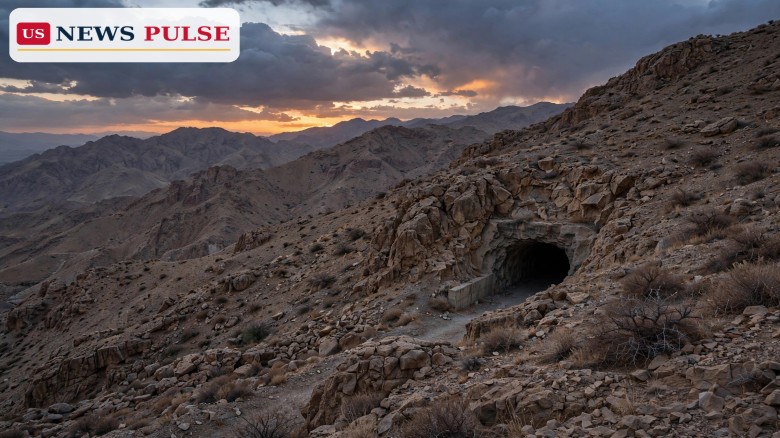
Featured image: an illustrative generated scene of a rugged mountain landscape, not a photograph of Pickaxe Mountain or of any person named in this article.
Leave a Comment