


 | Today's Date:
Turkey Qatar Defence Pact Signed, Vowing New United Front Against Attack
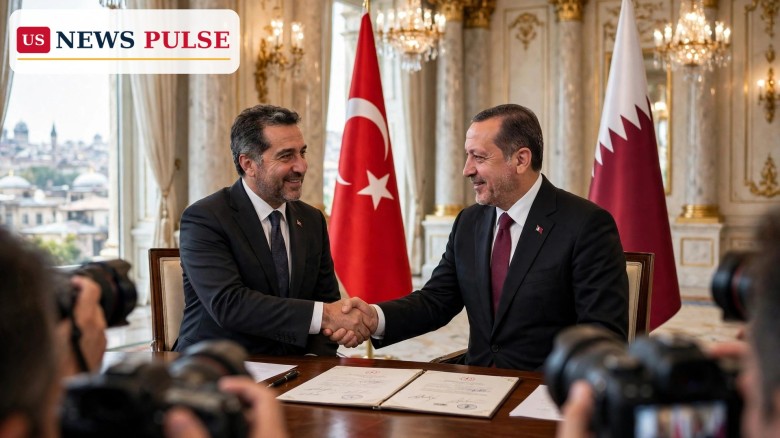
Turkey and Qatar signed a mutual defence agreement on Friday, November 13, 2026, pledging a unified stance against any external armed attack on either country, as the war between the United States and Iran grinds into its ninth month. The pact was signed in Istanbul during talks between Turkish President Recep Tayyip Erdogan and Qatar's Emir Sheikh Tamim bin Hamad Al Thani at the Presidential Dolmabahce Office, on the sidelines of the 12th session of the Turkiye-Qatar Supreme Strategic Committee. Under the agreement, the two countries promised to consult on security threats and to stand together if either faces an armed attack, while also expanding joint military exercises, defence-industry cooperation and personnel training.
Key Points
- Turkey and Qatar signed a mutual defence agreement on Friday, November 13, 2026, during the 12th session of the Turkiye-Qatar Supreme Strategic Committee in Istanbul.
- The two countries pledged a unified stance against any external armed attack on either country and promised to consult on security threats, invoking their sovereignty and territorial integrity.
- The pact also provides for expanded joint military exercises, defence-industry cooperation and personnel training, deepening a security partnership built over the past decade.
- President Recep Tayyip Erdogan said the agreement "will add a new dimension to the brotherly ties between the two countries", while the Emir called it a "strategic partnership".
- The signing comes days after Turkiye's parliament ratified the separate Mecca Joint Defence Agreement with Saudi Arabia and Pakistan.
What Happened
The signing took place at the Presidential Dolmabahce Office in Istanbul, where Erdogan hosted the Emir for the 12th session of the two countries' Supreme Strategic Committee, their top bilateral forum. The joint statement issued after the talks said the two sides had agreed on a unified stance against any external armed attack on either country and on consulting each other on security threats. It described the commitment as reflecting a shared vision of a more secure regional order and a determination to safeguard the sovereignty and territorial integrity of both states.
Four other agreements were signed alongside the defence pact, covering trade, education and diplomacy, plus a memorandum of understanding on peace, reconciliation and conflict resolution. Erdogan said both countries would work to prevent a renewed outbreak of war in the Gulf and to promote dialogue and peace, a message aimed squarely at the conflict raging across the waterway. Details of how the mutual-defence commitments would be implemented were not immediately released.
Background: A Decade of Turkiye-Qatar Security Ties
The pact builds on a decade of deepening security ties between Ankara and Doha. Turkiye has maintained a military base in Qatar since 2017, when it deployed troops during the blockade of Doha by Saudi Arabia, the United Arab Emirates, Bahrain and Egypt, and the two countries have held regular joint exercises ever since. Qatar, meanwhile, has become one of the Gulf's most active mediators, hosting talks between the United States and Iran and pressing for a negotiated end to the war that began on February 28, 2026.
The signing also follows days after Turkiye's parliament ratified the Mecca Joint Defence Agreement, a separate pact linking Ankara with Saudi Arabia and Pakistan that was concluded on August 7, 2026. Together, the two agreements place Turkiye at the centre of a web of Gulf defence commitments that did not exist a year ago, as regional states hedge against a war that has already disrupted shipping and energy markets across the Middle East.
Turkey Qatar Defence Pact: What the Agreement Covers
At its core, the agreement is a mutual-assistance pledge: an armed attack on one partner is treated as a matter for both, with the two governments committing to a unified stance and to consultation on security threats. The joint statement framed that commitment in terms of sovereignty and territorial integrity, the language states use when they want a pledge to carry weight without spelling out tripwires.
The practical clauses matter as much as the pledge. Expanded joint military exercises will put Turkish and Qatari forces through shared drills more often, defence-industry cooperation opens the door to joint production and procurement, and personnel training will deepen the ties between the two militaries. What remains unclear is the machinery behind the promise: no details were released on command arrangements or response timelines, leaving analysts to watch for the implementing texts.
Reactions and Official Statements
Erdogan presented the agreement as a milestone in a long friendship. "It will add a new dimension to the brotherly ties between the two countries," he said, adding that both sides would work to prevent a renewed outbreak of war in the Gulf and to promote dialogue and peace. The Emir, Sheikh Tamim bin Hamad Al Thani, described the agreement as a "strategic partnership" between the two countries.
The joint statement said the pact reflected "a shared vision of a more secure regional order". Neither government gave a timetable for the first exercises under the agreement.
Why It Matters
The pact matters because it changes the arithmetic of Gulf security in the middle of a war. With Hormuz shipping running about 65 percent below pre-war levels, according to United Kingdom Maritime Trade Operations, and 163 Iran-US conflict-related maritime incidents recorded since February 28, Gulf states are building formal guarantees rather than relying on informal assurances. For Qatar, the agreement adds a second major defence partner alongside the United States; for Turkiye, it extends the reach of the Mecca pact and cements Ankara's role as a Gulf security provider.
What Happens Next
Attention now turns to implementation. The two governments are expected to publish the implementing arrangements for the defence commitments, including the schedule for joint exercises and the scope of defence-industry projects. Observers will also watch whether other Gulf states seek similar pacts with Ankara, and how Washington and Tehran read a formal Turkiye-Qatar defence tie as the war continues.
Frequently Asked Questions
What did Turkey and Qatar agree?
A mutual defence agreement signed on November 13, 2026, pledging a unified stance against any external armed attack on either country, plus consultation on security threats, joint exercises, defence-industry cooperation and personnel training.
Where was it signed?
At the Presidential Dolmabahce Office in Istanbul, during the 12th session of the Turkiye-Qatar Supreme Strategic Committee, in talks between President Recep Tayyip Erdogan and Emir Sheikh Tamim bin Hamad Al Thani.
Is this the same as the Mecca defence pact?
No. The Mecca Joint Defence Agreement links Turkiye with Saudi Arabia and Pakistan and was ratified by Turkiye's parliament days earlier. The Qatar pact is a separate bilateral agreement.
Why now?
The pact comes as the US-Iran war continues into its ninth month, with Hormuz shipping about 65 percent below pre-war levels.
What happens next?
Implementation details, including exercise schedules and defence-industry projects, are still to be released. The two sides also signed four other agreements on trade, education, diplomacy and conflict resolution.
Related coverage: Mecca defence pact ratified as Turkiye approves Saudi-Pakistan alliance; Erdogan urges Trump to end US-Iran tensions through diplomacy in phone call; Qatar says US and Iran are reviewing mediator proposals for an interim deal.
Leave a Comment