


 | Today's Date:





Trump-Xi-Putin Trilateral Meeting Confirmed for APEC Summit in Shenzhen
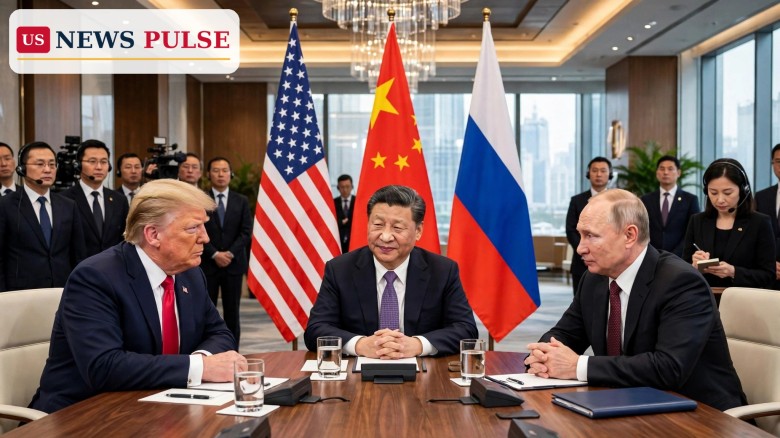
President Donald Trump will sit down jointly with Chinese President Xi Jinping and Russian President Vladimir Putin next week, the White House confirmed on Friday, in what would be the first-ever trilateral meeting between the leaders of the world's three biggest nuclear-armed states.
The meeting will take place on the sidelines of the APEC summit in Shenzhen, China, on November 18-19, 2026, with nuclear non-proliferation at the top of the agenda. Trump believes the talks could open the way to a new agreement on reducing nuclear weapons, though his own officials cautioned that no deal should be expected from a first conversation.
Key Points
- The White House confirmed on Friday, November 13, 2026, that President Donald Trump will meet jointly with Xi Jinping and Vladimir Putin at the APEC summit in Shenzhen.
- The meeting, on November 18-19, would be the first-ever trilateral sit-down between the leaders of the United States, China and Russia.
- Nuclear non-proliferation is the central topic, with Trump hoping the talks could lead to a new agreement on reducing nuclear weapons.
- The last nuclear arms treaty between the United States and Russia expired in February 2026, and China has been rapidly building up its nuclear arsenal.
- The leaders also plan to discuss Iran, and Tesla chief Elon Musk is expected to travel with Trump to China but will not attend the trilateral meeting.
What Happened
The White House announced the meeting on Friday, November 13, 2026, confirming that Trump will meet jointly with Xi and Putin on the sidelines of the APEC summit in Shenzhen — the first time the leaders of the world's three largest nuclear-armed states will sit in a single room together.
White House spokesperson Olivia Wales said nuclear weapons would be front and centre. "The President has made it clear that, among other topics, he will discuss the reduction of nuclear weapons in the world. This proliferation, President Trump believes, is very dangerous," Wales said.
Officials were careful, however, to lower expectations. A senior US official said the administration does not expect the meeting to produce an agreement, describing the talks as "the entry point, the first conversation, certainly at the leader level, between these countries" on nuclear issues. The leaders also plan to discuss Iran.
Background and Context
The road to Friday's confirmation has been uneven. Trump first raised the prospect of a meeting on nuclear disarmament in late October, calling denuclearisation "very important, perhaps the most important" of all. The idea of Putin joining had reportedly been floated by the Russian leader, and the Kremlin said only that the possibility had been raised.
On November 8, Trump said he thought he would meet both Xi and Putin in China at the APEC summit. But the following day a dispute over the format threatened to derail the plan. Friday's White House confirmation resolves that standoff and puts the meeting firmly on the calendar.
The timing matters because the guardrails that once governed the world's nuclear arsenals have largely fallen away. The last nuclear arms treaty between the United States and Russia expired in February 2026, leaving the two largest nuclear powers without a binding agreement for the first time in decades. China has been rapidly building its arsenal and has never been party to a bilateral arms-control treaty with Washington or Moscow.
Trump-Xi-Putin Trilateral Meeting: What Is on the Table
At the heart of the meeting is a simple but difficult question: can the three countries that hold the overwhelming majority of the world's nuclear weapons agree on a path to reduce them? Trump believes the answer could be yes, and the White House framed the talks as the start of a process rather than a single decisive negotiation.
Non-proliferation is the stated focus, but Iran is also on the agenda, with Washington keen to compare notes with Beijing and Moscow, which have their own channels to Tehran. What the meeting is not, according to US officials, is a deal-making session: a joint statement or a commitment to keep talking would count as progress. Tesla chief Elon Musk is expected to travel with Trump to China, but not to attend the meeting itself.
Reactions and Quotes
The White House announcement was deliberately measured. Wales presented the meeting as part of Trump's broader push to reduce nuclear danger, quoting the president's view that the current spread of nuclear weapons "is very dangerous". The senior US official struck a similar note of caution, calling the talks "the entry point, the first conversation, certainly at the leader level, between these countries" — the opening of a longer process, not a one-off event.
Why It Matters
A meeting of the leaders of the United States, China and Russia in one room is rare in any circumstances, and one devoted to nuclear weapons is rarer still. It comes at a moment when the formal architecture of arms control has all but disappeared: with the last US-Russia treaty expired since February and China outside any bilateral limits, no binding agreement restrains the arsenals of the three largest nuclear powers.
That vacuum is the reason the meeting matters even if it produces no agreement. Arms-control talks have traditionally taken years of negotiation by officials before leaders got involved. Trump is reversing that order, putting the leaders together first and betting that a personal conversation can create the political space for officials to follow. It is a gamble, and his own officials have been careful not to promise it will pay off.
What Happens Next
All eyes now turn to Shenzhen on November 18-19. The first test will be whether the three sides can agree on even a modest joint statement or a commitment to continue the conversation. Trump is also expected to meet Xi separately, and any separate session with Putin would be closely watched. If the meeting goes ahead as planned, the next question is what follows: whether officials are tasked with follow-up talks, and whether the language of non-proliferation turns into anything concrete. For now, the White House has set the bar low — a first conversation, not a deal.
Frequently Asked Questions
When is the Trump-Xi-Putin trilateral meeting?
November 18-19, 2026, on the sidelines of the APEC summit in Shenzhen, China.
Has a meeting like this happened before?
No. The White House said it would be the first-ever trilateral sit-down of the three leaders.
What will the leaders discuss?
Nuclear non-proliferation is the central topic, and the leaders also plan to discuss Iran.
Will the meeting produce a nuclear deal?
US officials say no agreement is expected. A senior official called the talks "the entry point, the first conversation" at leader level.
Why is there no nuclear arms treaty in force now?
The last US-Russia treaty expired in February 2026, and China has never been part of a bilateral arms-control treaty with Washington or Moscow.
Read more on the region: China has been staging major military drills around Taiwan ahead of the summit, with more than 100 vessels massed in the Pacific; Moscow has revived its demand that NATO pull back to its 1997 borders in Ukraine deal talks; and back home, Trump has just declared the air traffic control crisis a national emergency.
Leave a Comment