


 | Today's Date:



Iran Unveils Underground 'Missile City' as US Weighs Next Move After Qeshm Strikes
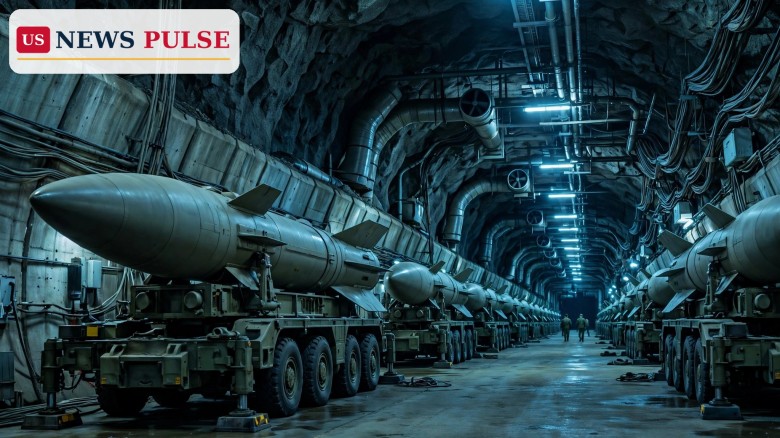
Iran's Islamic Revolutionary Guard Corps (IRGC) Aerospace Force unveiled a new underground "missile city" on Tuesday, releasing video of long tunnels lined with ballistic and cruise missiles and their launchers, as the United States weighs further military action after its strikes on Qeshm Island. Tehran presented it, during Aerospace Force Week, as proof its missile programme has survived nine months of war with the United States and Israel and moved deeper underground, beyond the reach of air strikes.
Key Points
- The IRGC Aerospace Force unveiled the underground complex on Tuesday, November 10, 2026, showing tunnels packed with ballistic and cruise missiles on mobile launchers.
- Armed Forces Chief of Staff Maj Gen Ali Abdollahi and Aerospace Force Commander Brig Gen Seyyed Majid Mousavi toured the site and reviewed its missile units' readiness.
- Iran did not say where the site is, how deep it lies or how many missiles it holds; none of the claims in the footage can be independently verified.
- The unveiling follows the IRGC's announcement on Saturday that missile and drone production has moved deep underground into "missile production cities".
- It comes as Washington weighs further action after its Qeshm Island strikes, while mediators push to prevent renewed escalation.
What Happened
Footage released on Tuesday showed cavernous tunnels in which rows of missiles stand on transporter-erector launchers, ready to be rolled out and fired. Senior officers inspected the facility during the ceremony and reviewed the readiness of its missile units, according to Iran's Mehr News Agency.
Abdollahi, who toured the site with Mousavi, said Iran's advanced missiles "will surprise the enemies" on the battlefield. The footage gave no indication of the site's location, depth or missile count, and the claims in the video cannot be independently verified.
The unveiling had been trailed three days earlier, when IRGC spokesman Brig Gen Hossein Mohebbi announced on Saturday, November 7, that the force would unveil a new underground missile city during Aerospace Force Week. Mohebbi said the force had moved its missile and drone production lines from surface facilities deep underground, beyond storage tunnels, to build what he called "missile production cities".
Inside Iran's Underground Missile City Network
Iran has shown off underground missile complexes for a decade, since the first "missile city" was revealed in 2015, presenting them as a core deterrent: weapons that can survive an air campaign and be fired back in retaliation. The new site is the latest in that series, but it arrives after nine months of open war in which Iranian surface facilities have been repeatedly struck.
Satellite imagery published last week suggested the rebuilding is real, even if the new complex's scale cannot be confirmed. A BBC Verify analysis found major construction at the Garmdareh missile base near Karaj and at Shahroud, including digging, new buildings and a possible new underground entrance, with repairs at a dozen other military sites.
Two days later, the IRGC announced it had lifted its self-imposed 2,000-kilometre limit on ballistic missile range, in place since 2017, with Mohebbi saying Iran would "demonstrate these capabilities in practice". An Israeli security assessment published on November 3 put Iran's ballistic missile stockpile at more than 1,700 missiles able to reach Israel — a force Tehran wants its adversaries to believe is growing harder to destroy.
Reactions and Quotes
Abdollahi's message was blunt. "Advanced missiles will surprise enemies with their battlefield impact," the Armed Forces chief of staff said, a warning aimed at Washington and Jerusalem.
Mohebbi's weekend briefing listed ten claimed achievements, including that the force destroyed more than 260 enemy aircraft during the war, among them F-35, F-16 and F-18 jets. That figure is unverified and unsupported by independent tallies. He also claimed the American THAAD system had proved ineffective against Iranian missiles.
Washington has not publicly responded to the unveiling. President Donald Trump said on Monday that Iran's military was "effectively over" and further strikes seemed "quite unlikely" for now, while warning the United States remained "locked and loaded" if circumstances changed. Vice President JD Vance said the same day Washington had made "progress" in talks with Iran and set no deadline for a deal, and mediators including Qatar have pressed both sides to keep diplomacy alive.
Why It Matters
The unveiling is, above all, a signal. Iran wants the United States and Israel to believe that destroying its missile force from the air is no longer possible, because the weapons that matter are now built and stored underground. If true, the military option the United States has used twice this month on Qeshm Island grows less effective, and the cost of any wider campaign rises.
But the signal comes with a large verification problem. Tehran has released no location, depth or inventory, and its past wartime claims have often been inflated. Satellite evidence of construction at known bases is real, yet it does not confirm the existence, size or readiness of the complex in Tuesday's footage. Until independent evidence corroborates it, the "missile city" is a claim about capability, not a proven fact.
That uncertainty matters because missiles sit at the centre of the diplomacy. Washington's top priority, Vance has said, is a firm, verifiable commitment that Iran will not rebuild its nuclear programme, which the United States says it destroyed. A missile force growing in range and survivability complicates any deal and gives Tehran's hardliners an argument against conceding.
What Happens Next
The immediate test is diplomatic. Trilateral talks between the United States, Russia and Ukraine opened in Abu Dhabi on Tuesday, and mediators are pushing to prevent the Iran war escalating again while negotiations continue. Trump has said a deal with Iran was "coming together very nicely", but no deadline has been set and the United States retains military and non-military options.
Analysts will watch for satellite imagery that might corroborate the new complex, further footage from Tehran, and the next American move. If the United States holds off, the unveiling will stand as evidence that Iran's missile programme is adapting to the war.
Frequently Asked Questions
What is a "missile city"?
It is Iran's term for a large underground tunnel complex used to store, and now according to Tehran to produce, ballistic and cruise missiles and their launchers, protected from air strikes.
Where is the new missile city?
Iran has not said. The location, depth and number of missiles were not disclosed, and the site cannot be independently identified from the footage.
How many missiles does Iran have?
An Israeli assessment published on November 3 estimated it at more than 1,700 ballistic missiles able to reach Israel. Iran has not published its own figures.
Why unveil it now?
It comes during Aerospace Force Week, days after the United States struck Qeshm Island and as Washington weighs further action — a deterrent signal aimed at the United States and Israel.
Does this change the war?
Not by itself. It suggests the programme is moving underground and becoming harder to destroy, but the claims are unverified, and the war's direction still depends on the diplomacy under way.
Related coverage: Iran Rebuilding Missile Bases as Satellite Images Show Underground Work and Iran Lifts 2,000km Missile Range Limit, Vowing to Show Longer Reach in Practice.
Leave a Comment