

 | Today's Date:




US Army Races to Build 17 Bunkers Across the Middle East as Iran Strikes Kill 23 Troops
The US Army is racing to build 17 reinforced concrete bunkers across Israel, Saudi Arabia and Lebanon to shield American and coalition troops from Iranian missile and drone attacks, after strikes that have killed at least 23 US service members since the war began in late February.
The Army is seeking contractors to build the shelters at five military installations, under a procurement notice posted on Friday, November 13, 2026. Ten bunkers will go up in Israel, five in Saudi Arabia and two in Lebanon, replacing makeshift shelters made from converted shipping containers.
Key Points
- The US Army is hiring contractors to build 17 reinforced concrete bunkers in Israel, Saudi Arabia and Lebanon.
- Ten bunkers will be built in Israel, five in Saudi Arabia and two in Lebanon, at five military installations.
- Iranian attacks on US installations have killed at least 23 American service members since late February 2026.
- Each bunker will have three precast concrete sections, steel entrance doors and roofs covered with at least 18 inches of sandbags.
- Contractors have three days to submit quotes, due by November 25, and 45 days to finish construction after a task order.
What Happened
The Army posted the notice on the federal contracting site sam.gov on Friday, citing "elevated regional force protection conditions" and an "urgent, high-priority requirement" to replace "nonstandard personnel protection shelters" — converted shipping containers — with standardised, precast, reinforced concrete indirect-fire bunkers.
The notice gives contractors an unusually short window. Citing "extreme operational urgency" because soldiers are "currently at risk using non-standard containerized shelters", the Army allows just three days for quotes, due by November 25, 2026, and 45 days to finish construction once a task order is issued.
The Army wants firms that can deploy to all three countries, and bidders must say whether they can work in Israel, Saudi Arabia and Lebanon or only in certain locations. The bunkers will go up at five installations — one in Israel and two each in Saudi Arabia and Lebanon — but the exact sites are being withheld for security reasons.
Background
The bunker rush follows nine months of Iranian attacks on American bases across the Persian Gulf. The war between the United States and Iran broke out in late February 2026, and Iranian strikes on US installations have killed at least 23 American service members since then.
The deadliest single attack came in March, when a drone strike on a US Army command post at Kuwait's Port of Shuaiba killed six American service members. Reports said the facility lacked adequate protection against aerial attacks, and a whistleblower has accused the Pentagon of ignoring warnings before the strike, as we reported in our coverage of the Port of Shuaiba whistleblower.
The attacks have not let up. On Tuesday, November 17, Iran claimed responsibility for another strike on a US military base in Bahrain, its third attack there in five days. The United States has hit back, including with the US strikes on Qeshm Island.
US Army Bunkers: What the 17 Shelters Will Look Like
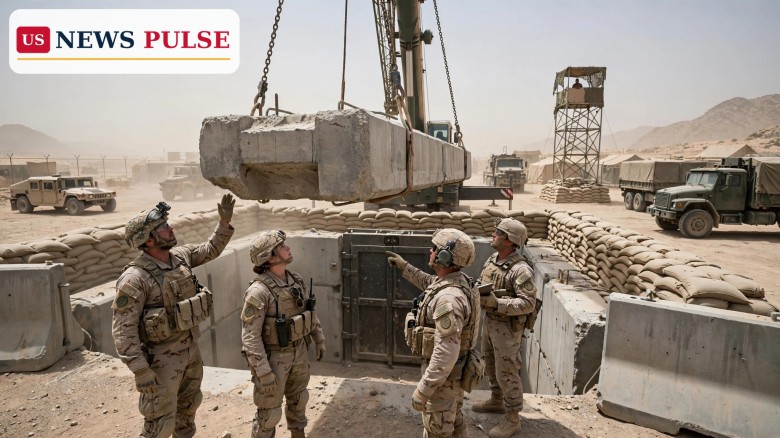
Each of the 17 bunkers will be built from three precast, reinforced concrete sections, giving troops a hardened shelter far stronger than the shipping containers they have been using. The steel entrance doors will be shielded by concrete barriers, the exterior walls will be reinforced with sandbags, and each roof will be covered with at least 18 inches of layered sandbags to protect against incoming fire.
The design is built for speed as much as for strength. Precast sections can be made off site and assembled quickly at the base, which is why the Army expects the work to be finished within 45 days of a task order. The notice states the goal plainly: "The objective is to safeguard U.S. and coalition service members operating in potentially hostile environments across multiple countries in [U.S. Central Command] Area of Responsibility."
Reactions
The Army's own words in the procurement notice leave no doubt about the urgency. It describes an "urgent, high-priority requirement" driven by "elevated regional force protection conditions", and warns of "extreme operational urgency" because soldiers are "currently at risk using non-standard containerized shelters".
President Donald Trump struck a different note on Monday, November 16, arguing that American defences have largely held. "Iran has fired between 8,000-9,000 One-way Attack Drones. Only 2 of them got through, resulting in U.S. fatalities, both on the first day, hitting Kuwait and Saudi Arabia. Likewise, Iran has fired about 2,000 Ballistic Missiles. Only 1 out of the 2,000 got through, and caused U.S. fatalities (Jordan)," he wrote on Truth Social. Fox News Digital said it has reached out to the Pentagon for comment.
Why It Matters
The bunker programme is the clearest sign yet that the Pentagon expects the threat to American troops in the Middle East to continue, not fade. Building permanent concrete shelters across three countries is a long-term investment in force protection, after months in which Iranian drones and missiles have repeatedly reached US bases despite some of the most advanced air defences in the world.
It also matters because of what it says about the war's human cost. At least 23 American service members have been killed, and the Shuaiba attack showed that some of those deaths happened at a base that, according to reports, lacked adequate aerial protection. The new bunkers are an admission that the makeshift shelters troops have relied on are not enough against the weapons Iran is now using.
What Happens Next
Contractors must submit their quotes by November 25, 2026, and the winning firms will then have 45 days to complete the work, putting the first finished bunkers on track for early 2027, if the timetable holds.
The fighting, meanwhile, shows no sign of stopping. Iran's third attack in five days on a US base in Bahrain and the strikes on tankers in the Strait of Hormuz point to a conflict still escalating, even as President Trump prepares to meet the leaders of China and Russia in Shenzhen on Thursday, November 19. The IAEA's warning on Iran's nuclear material adds to the pressure on Washington.
Frequently Asked Questions
How many bunkers is the US Army building in the Middle East?
The Army plans to build 17 reinforced concrete bunkers: 10 in Israel, five in Saudi Arabia and two in Lebanon, at five military installations.
Why is the Army building the bunkers now?
Iranian attacks have killed at least 23 American service members since late February 2026, and troops have been sheltering in converted shipping containers that offer limited protection.
What will the bunkers be made of?
Each bunker will have three precast reinforced-concrete sections, steel entrance doors shielded by concrete barriers, sandbag-reinforced exterior walls and roofs covered with at least 18 inches of layered sandbags.
When will the bunkers be finished?
Contractor quotes are due by November 25, 2026, and firms will have 45 days to finish construction after receiving a task order, putting completion in early 2027.
How many American troops have Iranian strikes killed?
At least 23 since late February 2026, including six in a March drone strike on a US Army command post at Kuwait's Port of Shuaiba.

The US News Pulse newsroom covers breaking news across the United States and the world, working from wire services, official statements and on-the-record sources. Every story is reviewed against our editorial standards before publication. Corrections and tips: info@usnewspulse.com
About our newsroomLeave a Comment