

 | Today's Date:


IRGC Says Three More Tankers Hit Mines in Strait of Hormuz Under US Escort
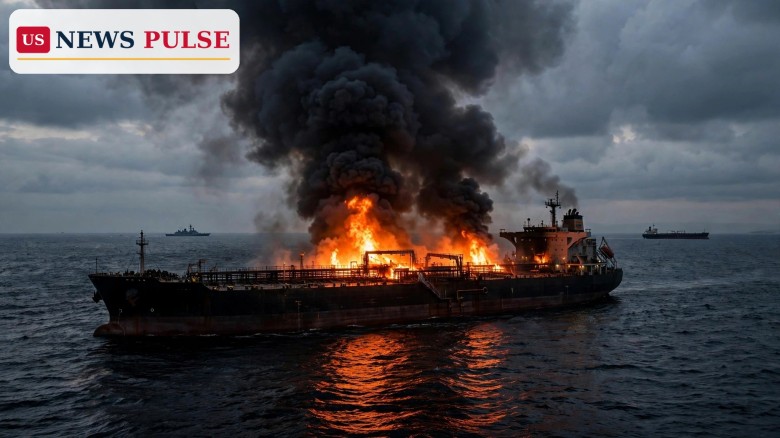
Iran says three more oil tankers struck naval mines in the Strait of Hormuz on Monday, exploding and catching fire while sailing under United States military escort.
Iran's Islamic Revolutionary Guard Corps (IRGC) Navy announced the claim early on Tuesday, November 24, 2026, in a statement carried by the state news agency IRNA. The statement said the three "violating" tankers hit mines in the strait, suffering severe explosions and intense fires. The claims are unverified, and US officials did not immediately comment.
Key Points
- Iran's Revolutionary Guard Corps said three oil tankers struck naval mines in the Strait of Hormuz on Monday, November 23, 2026, and caught fire.
- One tanker exploded off the southern coast; the other two struck mines in the east before midnight, the IRGC said.
- The IRGC said the tankers were under US military escort with air cover that "failed to prevent these incidents".
- The claims are unverified, and US Central Command has not responded.
- A satellite image dated November 23 shows smoke rising from a vessel off Oman.
What Happened
According to the IRGC statement, "three violating oil tankers in the Strait of Hormuz suffered severe explosions and fires after striking naval mines". One tanker exploded off the southern coast of the strait; the other two struck mines in the eastern part before midnight on Monday.
The IRGC said the tankers were being escorted and protected by the US military, but that American support "failed to prevent the incidents from occurring".
The IRGC also warned shipping. "The Strait of Hormuz is not a place for testing unauthorized routes and ignoring maritime warnings," the statement said, warning owners and shipping companies that "military cover and escort by the US military will not serve as a substitute" for complying with the IRGC Navy's directives.
Background and Context
The claim comes nine months into a war that began in late February 2026, when the United States and Israel launched a war on Iran. A framework agreement in June ended the main hostilities, but talks stalled over navigation through the Strait of Hormuz, and fighting has flared intermittently since July. The strait, barely 21 miles wide at its narrowest, is the only sea route out of the Gulf, and every tanker carrying Gulf oil must pass through it.
Attacks on shipping in and around the strait are at their highest level since the war began, per data cited by CNN on Monday and verified by The Jerusalem Post. Attacks reported to the Royal Navy-affiliated United Kingdom Maritime Trade Operations Centre (UKMTO) in the strait, the Persian Gulf and the Gulf of Oman numbered over 30 in October, the highest monthly figure since February, with at least 22 in November as of Sunday.
The November 23 claim is the latest in a run: on November 17 the IRGC said four ships were hit by mines; on November 19 it said two supertankers and a third tanker were hit; on November 22 two more supertankers were reported hit east of the strait.
Three Tankers Hit Mines in the Strait of Hormuz
The new claim fits a pattern of the past two weeks: Iranian announcements of mine strikes against tankers Tehran calls violators of its navigation rules, followed by warnings that American escorts offer no protection.
What makes the November 23 claim different is the direct challenge to the American escort: the statement said the tankers were under US military escort with extensive air cover, and that the escort failed. That turns a shipping incident into a test of American protection in the waterway, aimed as much at shipowners and insurers as at Washington. If owners believe an escort cannot keep a tanker safe, they may reroute or demand far higher insurance premiums.
The satellite image dated November 23 is the only publicly reported evidence that something burned at sea, and it does not confirm the IRGC's account: it does not identify the vessel or establish that three ships were hit. No vessel names or casualty figures were given, and no independent confirmation had emerged.
Reactions and Quotes
The IRGC statement, carried by IRNA, was the only official account at publication. It said the three tankers "suffered severe explosions and fires after striking naval mines", and that the tankers were being escorted by the US military, whose support "failed to prevent the incidents from occurring". It warned that passage through unauthorised routes "will be considered a violation and collaboration with aggressor forces".
There was no immediate US response: US Central Command (CENTCOM) has not responded, and no American official had commented when the reports were published.
Why It Matters
The Strait of Hormuz is one of the world's most important oil-shipping chokepoints. About a fifth of the world's seaborne oil has historically moved through it, so even unverified claims of mine strikes feed the risk calculations behind shipping costs, insurance rates and oil prices. A run of claims can raise the cost of moving oil even if no ship is confirmed sunk.
The claims also matter because they describe a war that has not ended. The June framework stopped the main fighting, but diplomacy has stalled over the strait's navigation rules, and fighting has flared repeatedly since July, with mine strikes, drone claims and cyberattacks on tankers all part of the same campaign.
What Happens Next
First, watch whether the United States responds: confirmation, denial or continued silence will each shape how the claims are read, most likely from the Pentagon or US Central Command. Second, watch shipping: operators will look for new route warnings, insurance changes and any further claimed mine strikes. The November 22 supertanker strikes and the November 17 four-ship wave both came amid the same campaign, and the November 17 double claim paired mine strikes with drone shoot-downs.
Frequently Asked Questions
What does Iran claim happened on November 23?
Iran's Revolutionary Guard Corps said three oil tankers struck naval mines in the Strait of Hormuz on Monday, November 23, 2026, suffering severe explosions and fires: one off the southern coast, and two in the eastern part before midnight.
Were the tankers under American escort?
The IRGC said so, but the claim is unverified and US officials have not commented.
Has the claim been independently verified?
No. A satellite image dated November 23 shows smoke rising from a vessel off Oman, but it does not identify the vessel or confirm that three ships were hit. No vessel names or casualty figures were given.
How many attacks on shipping have been reported in the strait?
Attacks reported to the United Kingdom Maritime Trade Operations Centre in the strait, the Persian Gulf and the Gulf of Oman numbered over 30 in October 2026, the highest monthly figure since the war began, with at least 22 reported in November as of Sunday.
Why does the Strait of Hormuz matter so much?
The strait is the only sea route out of the Gulf and one of the world's most important oil-shipping chokepoints. Disruption there affects oil prices, shipping costs and insurance rates, which is why every incident there draws worldwide attention.

The US News Pulse newsroom covers breaking news across the United States and the world, working from wire services, official statements and on-the-record sources. Every story is reviewed against our editorial standards before publication. Corrections and tips: info@usnewspulse.com
About our newsroomLeave a Comment