

 | Today's Date:





Muslims to Outnumber Christians by 2035 in Historic Shift, Pew Research Finds
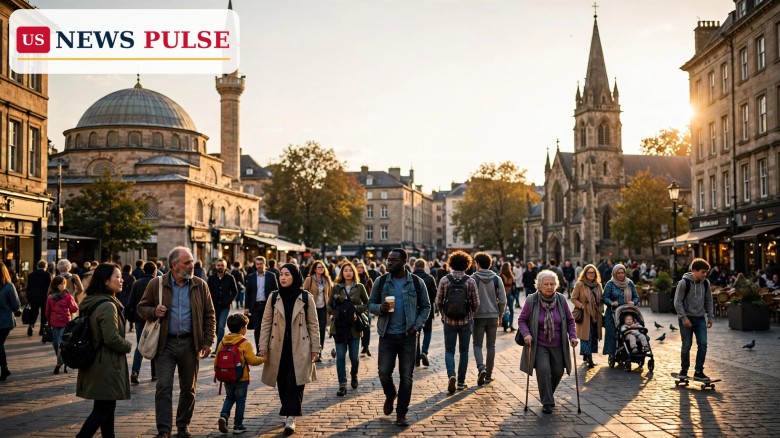
Muslims will outnumber Christians by 2035, ending centuries in which Christianity has been the world's largest religion, according to new projections from the Pew Research Center. The crossover is expected within a decade: 2.57 billion Muslims against 2.52 billion Christians in 2035, up from 2.02 billion Muslims and 2.27 billion Christians in 2020. The shift is driven by births, not by people changing faith, and both religions are projected to keep growing for decades.
Key Points
- Pew Research Center projects Muslims will pass Christians as the world's largest religion by 2035: 2.57 billion Muslims against 2.52 billion Christians.
- Both faiths keep growing: Muslims by 80 per cent and Christians by 30 per cent between 2020 and 2070.
- Births drive the gap: Muslim women averaged 3.1 children in 2020-25, against 2.5 for Christian women and 1.6 for all others.
- Switching barely moves the balance: a net loss of 8 million Muslims and 105 million Christians by 2070.
- Pakistan is projected to pass Indonesia for the most Muslims; the Democratic Republic of Congo is set to pass the US for the most Christians.
What Happened
Pew released the projections on Tuesday, November 18, 2026, in a study titled "The Future of World Religions: Population Growth Projections, 2020-2070," covering seven religious groups in 201 countries and territories holding 99.98 per cent of humanity. By 2070 Pew expects more than 3.6 billion Muslims — 36 per cent of the global population, up from 26 per cent in 2020 — and just under 3 billion Christians, steady at about 29 per cent.
The study is part of the Pew-Templeton Global Religious Futures project. Its model was built with researchers at the Centre for Advanced Studies of Population and Religion (CASPAR) at Krakow University of Economics, using census and survey data, fertility figures, migration flows and past switching patterns, alongside the United Nations' 2024 World Population Prospects. Pew stresses the figures are projections, not predictions: wars, disasters, epidemics and social change are not modelled.
Background and Context
Christianity has been the world's largest religion for centuries, so a change at the top of the ranking is historic in itself. What makes the finding striking is how soon it is expected — within nine years — and how little it owes to conversion. The engine is demography: younger Muslim populations with higher birth rates add far more Muslims than Christians each generation.
The United States runs against the global Christian trend. America had the world's largest Christian population in 2020, 217 million, but Pew projects the largest decline anywhere, to 174 million by 2070, as deaths outnumber births and many leave the faith. Globally, though, Christianity still grows — overwhelmingly in sub-Saharan Africa, where Christians are projected to rise 129 per cent between 2020 and 2070, even as the region's Muslims rise faster, by 166 per cent.
Muslims Outnumber Christians: The Numbers Behind the 2035 Crossover
The gap is built almost entirely on natural population change — births minus deaths. Between 2020 and 2070, Muslims are projected to gain 1.6 billion people through natural increase, against 792 million for Christians. Fertility tells the story: 3.1 children per Muslim woman and 2.5 per Christian woman in 2020-25, against 1.6 for all others. A generation replaces itself at around 2.1 children per woman, so Muslim fertility sits well above replacement while Christian fertility is only just above it.
Switching barely registers. Muslims are expected to lose a net 8 million people through switching over the projection period, and Christians a net 105 million, most becoming religiously unaffiliated. Movement between the two faiths roughly cancels out: about 9.2 million raised Muslim are projected to become Christian, against 9.0 million the other way. As Pew puts it, Islam's projected growth is not due to people who convert from Christianity.
Geography concentrates the change. Muslims were the majority in 53 countries in 2020, and 1.2 billion more Muslims are expected in those countries by 2070 — 74 per cent of the projected growth. Pakistan's Muslim population is expected to double from 227 million to 461 million, passing Indonesia as the world's largest. In the Democratic Republic of Congo, the Christian population is expected to triple from 92 million to 299 million. By 2070 Muslims will make up 95 per cent of the Middle East-North Africa region; Asia-Pacific is the only region where the largest group changes, with Muslims passing the unaffiliated.
Reactions and Quotes
Pew's own summary is deliberately measured. "Despite this shift, Muslim population growth will not slow the rise of the Christian population. Both groups will see their numbers increase in the decades ahead," the centre wrote, adding: "The results are not intended to predict all the ways the world could change." The centre published the full report with an interactive data explorer.
Why It Matters
A change at the top of the world's religious ranking matters because faith shapes how billions of people live, vote, raise children and mark the calendar. The gap in 2035 will be narrow — about 50 million out of nearly 8.5 billion — but the direction is set, and growth is concentrated in sub-Saharan Africa and Muslim-majority countries, so the religious map of the coming decades will be written largely in Lagos, Kinshasa, Karachi and Jakarta.
For the United States the contrast is sharp: American Christianity is shrinking even as global Christianity grows. Muslim Americans are more visible in public life than ever — Abdul El-Sayed won Michigan's Senate contest to become the first Muslim senator. Read more: Abdul El-Sayed to take Senate oath on Quran in historic first for US Senate. Pope Leo XIV's first trip to Latin America, weeks after lung cancer surgery, underlines how the Catholic Church is already looking to the Global South. Read more: Pope Leo XIV begins first Latin America trip weeks after lung cancer surgery.
What Happens Next
The crossover is about nine years away, and much can move it. If birth rates fall faster than expected in Muslim-majority countries, 2035 could slip later; if Christian disaffiliation accelerates in the West, it could arrive sooner. Watch the milestones: Pakistan passing Indonesia for the most Muslims, the Democratic Republic of Congo passing the United States for the most Christians, and the Muslim share of humanity climbing toward 36 per cent by 2070.
Frequently Asked Questions
When will Muslims outnumber Christians?
By 2035, Pew projects 2.57 billion Muslims against 2.52 billion Christians, up from 2.02 billion and 2.27 billion in 2020.
Is the shift caused by conversion?
No — by births. About 9.2 million raised Muslim are projected to become Christian, against 9.0 million the other way, so switching roughly cancels out.
Will Christianity shrink?
No. Christians are projected to grow 30 per cent between 2020 and 2070, to just under 3 billion, though their share stays at about 29 per cent while Muslims rise to 36 per cent.
Which countries will have the largest Muslim and Christian populations?
Pakistan, reaching 461 million by 2070, passes Indonesia as the country with the most Muslims; the Democratic Republic of Congo, reaching 299 million, passes the US as the country with the most Christians.
Are these projections certain?
No. Pew stresses they are projections if recent trends continue, not predictions. Wars, disasters, epidemics and social change are not modelled.

The US News Pulse newsroom covers breaking news across the United States and the world, working from wire services, official statements and on-the-record sources. Every story is reviewed against our editorial standards before publication. Corrections and tips: info@usnewspulse.com
About our newsroomLeave a Comment