


 | Today's Date:




Bukele's Troops Retake Haiti's Sylvio Cator Stadium From Gangs - US News Pulse
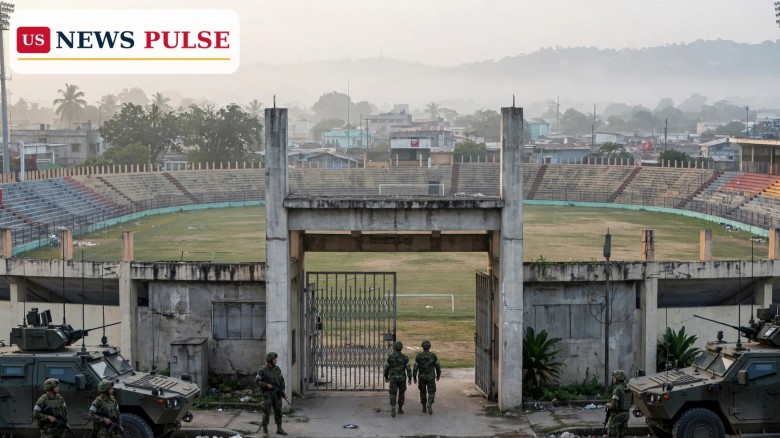
Haitian and Salvadoran forces have retaken the Sylvio Cator Stadium in downtown Port-au-Prince, Haiti's largest stadium, from the gangs that had held it since 2024, in a predawn raid on Thursday, November 12, 2026. Haitian police said they had taken "full control" of the ground before handing it to Salvadoran soldiers, who will turn it into a base for a wider offensive in gang-held neighbourhoods.
During the operation, troops found several human skulls inside the stadium, a grim discovery that President Nayib Bukele announced himself, and one that has not yet been independently verified. Over 20 armoured vehicles and trucks are now stationed inside, and Bukele has warned gang members to leave before the offensive begins.
Key Points
- A joint operation by the Haitian National Police, the Haitian Armed Forces, the government Task Force and Salvadoran Special Forces retook the stadium in a predawn raid on Thursday, November 12, 2026.
- Haitian police said they took "full control" and handed the stadium to Salvadoran soldiers, with 20-plus armoured vehicles and trucks now stationed inside.
- President Nayib Bukele said the stadium will become a base to push "deeper into gang-controlled territories" and warned gang members to leave before an offensive.
- Several human skulls were found inside the stadium during the operation; the claim has not yet been independently verified.
- Bukele released video showing Salvadoran forces using combat robot dogs fitted with assault rifles to track gang members.
What Happened
The operation began before dawn on Thursday, when Haitian and Salvadoran troops moved on the stadium in the heart of Port-au-Prince. The Haitian National Police said it had taken "full control" of the Stade Sylvio Cator, working alongside the Haitian Armed Forces, the government Task Force and El Salvador's Special Forces. Salvadoran state media then announced that its forces had been handed control of the ground.
"Under the bilateral agreement between the governments of Haiti and El Salvador, a joint operation involving the Haitian National Police, the Haitian Armed Forces (FAd'H), the Task Force, and El Salvador's Special Forces successfully took control of Sylvio Cator Stadium and secured it," Bukele announced on Thursday. "During the operation, we discovered several human skulls inside the stadium."
Bukele said the stadium will serve as a base for an offensive against the gangs, and he demanded that gang members leave the area before it begins. Video he released showed Salvadoran forces deploying combat robot dogs fitted with assault rifles to track gang members. The stadium, which holds about 10,000 people, had been in gang hands since 2024, forcing Haiti's national team to play World Cup qualifiers in Curacao, more than 500 miles away.
Background: How Gangs Took the Sylvio Cator Stadium
The Sylvio Cator Stadium is Haiti's national stadium, named after the Haitian athlete who won silver in the long jump at the 1928 Olympics. For decades it hosted the national team and Haitian football's biggest matches, until the gangs that now control much of Port-au-Prince seized it in 2024 along with large parts of the capital. With no elected leaders for years and about 1.5 million people displaced by gang violence, the stadium became one more symbol of a state that had lost control of its own capital.
El Salvador's involvement began after four Salvadoran military technicians were ambushed by gangs outside Port-au-Prince on October 18, 2026. The four air force technicians, returning to base from a market, leapt from a burning vehicle during the attack and have not been seen since. Bukele believes they are being held hostage, although 400 Mawozo leader Wilson Joseph has denied holding them. El Salvador sent around 1,000 soldiers to Haiti in the days after the ambush, and the contingent has since grown to more than 2,000 personnel.
On November 3, Haitian police found the burned remains of the truck used by the four missing technicians in Croix-des-Bouquets, outside the capital. Salvadoran troops then launched their first major operation in Haiti on November 2, in the Cul-de-Sac plain. On Tuesday, Bukele said his troops had destroyed a mansion belonging to Wilson "Lanmò San Jou" Joseph, leader of 400 Mawozo, after crowdsourcing its coordinates on X.
Reactions and Quotes
Bukele announced the stadium operation himself, posting video of the raid and the robot dogs to his millions of followers on X. On November 4 he had warned gang leaders that his forces would "finish" them, as he said he did in El Salvador. His message on Thursday was simpler: leave the area before the offensive begins.
Haitian police framed the operation as a joint success, crediting the National Police, the Armed Forces, the Task Force and the Salvadoran Special Forces together. There has been no public response yet from the gangs, and no independent confirmation of the skulls. The discovery, if confirmed, would point to killings inside the stadium during its two years under gang control.
Why It Matters
The stadium matters for three reasons. First, it is symbolic: the national stadium is one of the most recognisable public buildings in Port-au-Prince, and taking it back shows the gangs can be pushed out of ground they have held for two years. Second, it is practical: as a fortified base in the centre of the capital, it gives Haitian and Salvadoran forces a staging point for operations deeper into gang-held neighbourhoods. Third, it tests the Salvadoran model abroad: whether a force sent to find four missing men can anchor a wider campaign to retake the capital.
There are risks too. The skulls are a reminder of what gang rule meant for the people who lived under it. And the robot dogs show how far the mission will go with military technology in a crowded city, certain to draw scrutiny from rights groups already critical of Bukele's methods at home.
What Happens Next
Bukele has made the next step clear: an offensive from the stadium base, deeper into gang-controlled territory, warning gang members to leave first. Whether the gangs fight, melt away or regroup elsewhere will decide how quickly that offensive can move. Two questions will follow: what investigators find inside the stadium, and whether the four missing Salvadoran technicians are found, since their fate was why the troops came to Haiti.
Frequently Asked Questions
Where is the Sylvio Cator Stadium?
In downtown Port-au-Prince, the capital of Haiti. It is the country's largest stadium, holding about 10,000 people, and home of the national football team.
Who retook the stadium from the gangs?
A joint operation by the Haitian National Police, the Haitian Armed Forces, the Task Force and Salvadoran Special Forces, in a predawn raid on Thursday, November 12, 2026.
What were the human skulls found inside the stadium?
President Nayib Bukele said several human skulls were found inside the stadium during the operation. The claim is unverified, and the remains have not been identified.
Why are Salvadoran troops in Haiti?
El Salvador sent troops after four of its military technicians went missing in a gang ambush outside Port-au-Prince on October 18, 2026. The contingent has grown to more than 2,000 personnel.
What happens next in Port-au-Prince?
Bukele says the stadium will become a base for an offensive deeper into gang-held territory, and has warned gang members to leave before it begins.
Leave a Comment